
The NBA salary cap is not a cap. That is the first thing to understand about it, and the reason every explainer that starts with "teams can spend up to X" immediately falls apart. The cap is a soft line that teams cross constantly and legally, surrounded by a thicket of exceptions that let good teams keep their own players and a set of escalating financial penalties that make keeping too many of them ruinous. In 2026-27 the cap sits at $164.961 million, and the most expensive teams in the league will finish the season more than $50 million past it. Here is what every number in the system actually does, why the second apron has become the most feared line in the sport, and how the whole structure decides which contenders stay together.
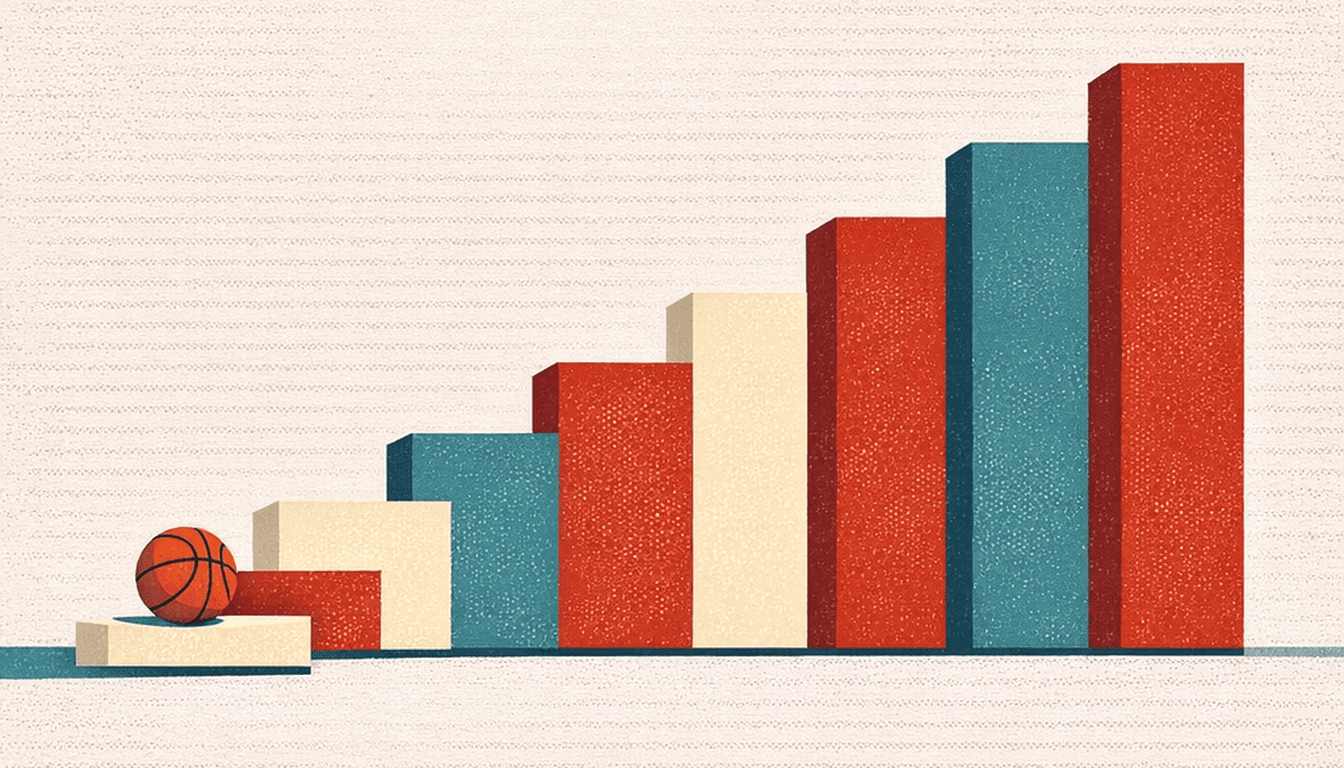
The Cap Is Soft, Which Is the Whole Point
A hard cap is a wall: spend to the number and stop. The NBA has never had one. It has a soft cap, which functions less like a wall and more like a toll booth. Teams may exceed it, but only through specific, named exceptions, and every dollar past certain thresholds costs progressively more.
The design goal is continuity. If the cap were hard, a team that drafted and developed three stars would be legally unable to pay all three, and rosters would churn every summer. The exception system exists so that a team can keep the players it developed. The tax and apron system exists so it cannot keep everyone forever. The entire structure is a negotiation between those two ideas.
The Five Numbers That Matter in 2026-27
Everything in team building keys off five thresholds, all of which rose about 6.5% from the previous season:
- Salary cap: $164.961 million. The baseline. Only teams below it have genuine "cap space" to sign outside free agents outright.
- Minimum team salary: $148.465 million. Teams must spend at least this much, or the shortfall is distributed to the players. There is a floor as well as a ceiling.
- Luxury tax line: $200.428 million. Cross it and you start paying a penalty on every dollar.
- First apron: $209.015 million. The first set of roster-building restrictions kicks in.
- Second apron: $221.686 million. The hardest line in the sport.
Note the gap between the cap and the tax line: more than $35 million. A team can be $35 million "over the cap" and owe nothing at all. This is why "over the cap" and "in the tax" mean completely different things, and why the phrase "cap space" is far rarer than casual coverage implies. Most seasons, only a handful of teams have any.
Bird Rights: Why Teams Can Outbid Everyone for Their Own Players
The most important exception is named after Larry Bird. In short: a team can exceed the salary cap to re-sign its own free agent, and it is the only way most contenders retain anybody.
Full Bird rights attach when a player has spent three seasons with the same team, whether that is one three-year contract, three one-year deals, or any combination. They let the team go over the cap to re-sign him for up to the maximum. Early Bird rights vest after two seasons and permit a smaller raise. Non-Bird rights, after a single season, cap the new deal at 120% of his previous salary.
The practical effect is that an incumbent team can always offer more than a rival. It can exceed the cap to do it, offer an extra guaranteed year, and grant larger annual raises. A rival with cap space is bidding with one hand tied behind its back. When a star does leave in free agency, it is almost never because another team simply outbid his own.
The Mid-Level Exception
Teams over the cap are not limited to re-signing their own players. The mid-level exception is the main tool for adding someone new, and it comes in three sizes for 2026-27:
- Non-taxpayer mid-level: $15.044 million. For teams over the cap but under the first apron.
- Taxpayer mid-level: $6.064 million. For teams between the aprons. Less than half the value.
- Room mid-level: $9.366 million. For teams that used up their cap space first.
Watch that middle number. A team that crosses the first apron sees its primary free-agent tool cut by nearly $9 million, which is the difference between signing a quality starter and signing a backup. Teams over the second apron have no mid-level at all.
What a Max Contract Actually Is
There is no single maximum salary. There are three, keyed to how long a player has been in the league:
- 25% of the cap for players with zero to six years of service
- 30% of the cap for players with seven to nine years
- 35% of the cap for players with ten or more years
This is why a superstar's first extension is worth so much less than a veteran's. A fourth-year All-NBA player and a twelve-year All-NBA player can be equally valuable and legally separated by ten points of cap percentage. It is also why young stars are the most valuable assets in the sport: they are the only players whose production can exceed their maximum legal price by a wide margin.
The Supermax
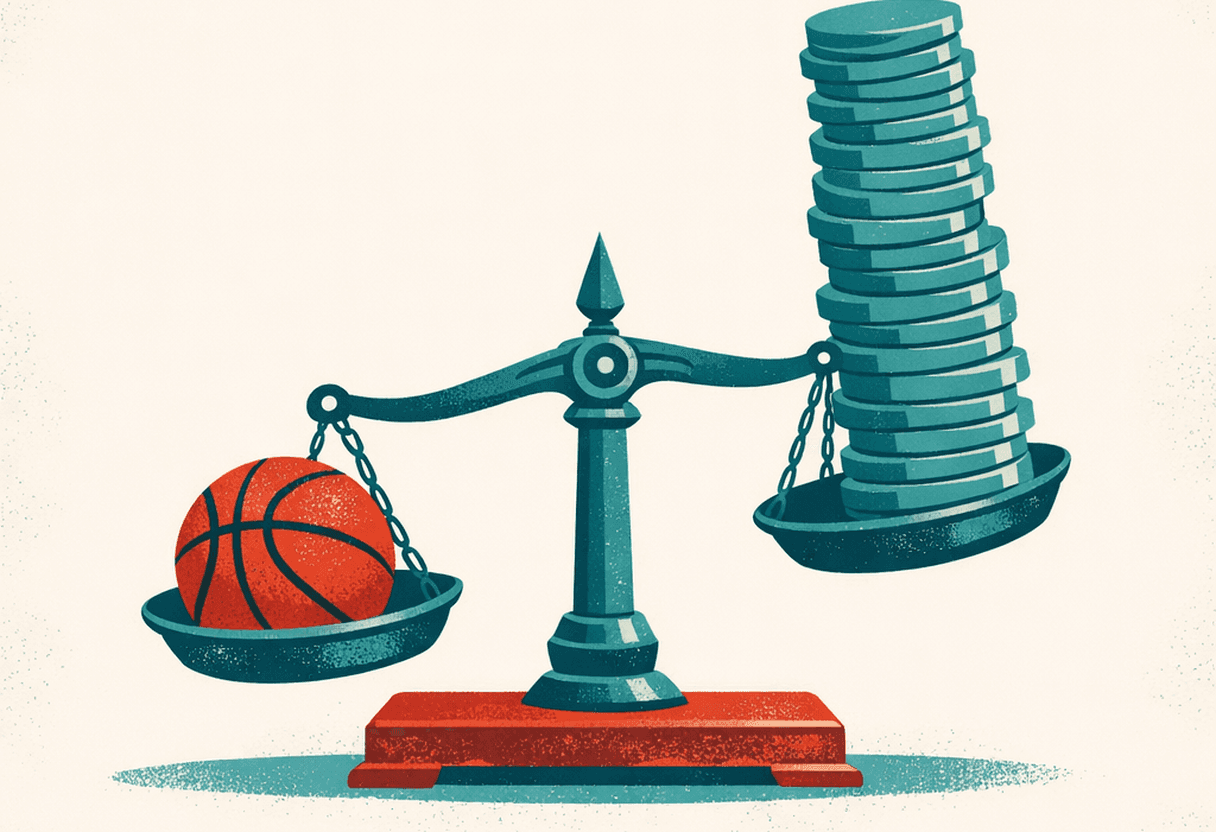
The designated veteran extension, universally called the supermax, lets a player reach the 35% tier early. To qualify he must have seven or eight years of service, still be with the team that drafted him, and have hit one of three achievement triggers: an All-NBA selection in the previous season or in two of the last three, Defensive Player of the Year on the same timeline, or MVP in one of the last three seasons.
The supermax is the league's strongest anti-movement device and its most notorious trap. It pays a player roughly a third of the cap for five years, and because eligibility is decided by awards voting rather than by a team's own judgment, a front office can be forced to choose between paying a declining star an enormous premium or losing him for nothing. Several franchises have had their entire decade shaped by that single decision.
The Luxury Tax
Cross $200.428 million and the bill starts. The tax is charged per dollar over the line, in escalating brackets, so the deeper a team goes the more each additional dollar costs.
The real teeth are in the repeater penalty. A team that has paid the tax in three of the previous four seasons becomes a repeater, and for 2026-27 the repeater rates begin at $3.00 per dollar and climb through $3.25, $5.50, and $6.75, rising another $0.50 for each bracket beyond. Sustained success is taxed far harder than a one-year splurge, and a team can reset the clock only by spending two seasons under the line.
The numbers get absurd quickly. When Golden State finished more than $40 million over the tax line in 2023-24 as a repeater, the bill came to an estimated $177 million, roughly $40 million more than the same roster would have cost a first-time taxpayer.
The First Apron
Nine million dollars above the tax line sits the first apron, and crossing it changes what a team is allowed to do rather than just what it pays. First-apron teams lose the full mid-level exception, cannot acquire players via sign-and-trade, and cannot sign a player who was waived if his previous salary exceeded the non-taxpayer mid-level.
That last restriction matters more than it sounds. The buyout market is where contenders historically added rotation help for free in February. The apron rules closed that door for the teams most likely to want it.
The Second Apron: The Hardest Line in the Sport
At $221.686 million, the second apron stops behaving like a tax and starts behaving like a wall. Teams above it:
- Cannot aggregate salaries in a trade. No combining two contracts to match one bigger one. Every trade must be one-for-one or better.
- Must match salary within 110% rather than the 125% available to teams in good standing.
- Cannot send cash in any trade.
- Cannot use any mid-level exception.
- Cannot use trade exceptions generated in a previous year.
- Cannot sign a waived player whose prior salary topped the mid-level.
Read that list as a whole and the picture is stark. A second-apron team cannot meaningfully improve itself. It can swap one contract for a similar contract and nothing else. The most expensive rosters in the league are the ones with the fewest legal ways to fix their own weaknesses, which is precisely what the 2023 collective bargaining agreement set out to accomplish.
The Frozen Pick
The second apron's harshest penalty is not financial at all. Finish a season above the second apron and the team's first-round pick seven drafts into the future is immediately frozen: it cannot be traded.
If the team goes over the second apron again in two of the next four seasons, that frozen pick is penalized outright and drops to the 30th selection in the first round regardless of the team's record. A club that spends heavily, ages badly, and collapses can find itself holding a top-five record's worth of misery and a pick that lands at 30 anyway. If the team stays under in enough subsequent years, the pick unfreezes.
This is the rule that makes front offices genuinely afraid. A tax bill is money, and the wealthiest owners have plenty. A pick that automatically becomes the last selection of the first round is a permanent asset, taken.
Rookie Contracts: The Cheapest Asset in the Sport
Nothing in the cap system creates more competitive advantage than a first-round pick who turns out to be good.
Every first-rounder signs the same shape of deal: four years, with the first two fully guaranteed and the last two as team options. The dollar figure is fixed by draft slot on a published scale, and teams may pay between 80% and 120% of it. In practice essentially everyone pays the full 120%, because the savings are trivial and the goodwill is not.
The scale itself is pegged to the salary cap, so rookie deals rise with league revenue. What does not rise is the relationship between the slot and the player. The number one pick is paid like the number one pick whether he becomes an All-NBA guard or never starts a game. Draft slot, not production, sets the price for four years.
That is the entire arbitrage of team building. A star on a rookie deal can be worth three or four times his cap number, and every rebuild is fundamentally an attempt to accumulate as many of those mispriced years as possible before they expire. Second-round picks and undrafted players extend the same logic further down: many sign two-way contracts, which let a player with four or fewer years of service move between the NBA roster and the G League affiliate while staying under team control at a fraction of a standard salary.
The window closes on a schedule. Four years after the draft, the rookie deal expires, the player becomes eligible for a percentage-of-the-cap maximum, and the cheapest asset in the sport turns into one of the most expensive.
Why Champions Get Expensive, Then Get Dismantled
Put it together and the life cycle of a contender is written into the cap sheet.
A team drafts well, and for three or four years its best players are on rookie-scale contracts worth a fraction of their production. This is the window: cheap stars, cap room, exceptions available, full trade flexibility. The team wins.
Then the extensions land. The 25% max becomes a 30% max. Bird rights let the team keep everyone, and because it can, it does. Salary climbs past the tax line, then the first apron, then the second. Now the mid-level is gone, salaries cannot be aggregated, the buyout market is closed, and a future first is frozen. The roster is expensive, aging, and legally frozen in place.
The 2023 CBA did not ban dynasties. It made them expire on a schedule. The teams that stay good longest are the ones that keep finding the next cheap star before the last expensive one has to be paid.

Related Reading
- How NBA Trades Actually Work
- How the NBA Draft Lottery Works: Odds and Rules
- NBA Players Who Won Titles With Multiple Teams
- One-Team Legends: NBA Stars Who Spent Their Entire Career With One Franchise
Every roster decision in Career Mode runs on the same tension: keep the players you developed, or stay flexible enough to add the next one. Test your front-office recall with our daily NBA Bingo board.