
Most NBA trade rumors die for a reason nobody reports: the deal was never legal. Two general managers can agree on player value, agree on draft compensation, shake hands, and still be unable to file the transaction, because the salaries do not match, or one team is over an apron, or a pick they wanted to include cannot be traded for another two years. Trade season is fundamentally a legal exercise dressed up as a talent exercise. Here is the actual rulebook: how salary matching works, what the two aprons forbid, why some future first-round picks are untouchable, and which players simply cannot be moved on a given date.

Why Salary Has to Match at All
A team under the salary cap can absorb an incoming contract into its cap space and send nothing back. That is the simple case, and it is rare, because most seasons only a handful of teams have real cap room.
Everyone else is over the cap, and a team over the cap has no space to absorb anything. It can only make a trade work through the traded player exception, which is the mechanism that requires outgoing salary to roughly match incoming salary. This is why so many trades include a player nobody wanted on either side. He is not a throw-in. He is the salary that makes the transaction legal.
The Matching Math for Ordinary Teams
For a team below both aprons, the allowance is generous and scales with the size of the contract being moved. Smaller salaries get the most latitude, in percentage terms, because doubling a $3 million contract is a rounding error against a $165 million cap. Larger salaries get proportionally less.
The practical range in 2026-27 is wide. A non-apron team sending out a $10 million contract can legally bring back as much as $19,096,000 in salary. That is nearly double, and it is the single biggest reason mid-payroll teams are the most active traders in the league: they can upgrade meaningfully in one transaction without having to construct an elaborate multi-team deal.
For very large contracts the allowance tightens toward roughly 125% of what is sent out. A max player is close to a one-for-one proposition no matter who is trading him.
The Apron Tiers Change Everything
Salary matching is generous only if a team is below both aprons. Cross either line and the mechanism narrows sharply.
Over the first apron ($209.015 million in 2026-27), a team cannot use outgoing salary to take back more than 100% of what it sends out. The cushion disappears entirely. Send out $20 million, bring back at most $20 million. A first-apron team also cannot acquire a player by sign-and-trade, cannot use the bi-annual exception, cannot use the non-taxpayer mid-level to absorb a player via trade or waiver claim, and cannot use a traded player exception generated in the prior year.
Over the second apron ($221.686 million), everything above still applies and more is stripped away. A second-apron team cannot use any portion of the mid-level exception, cannot send out cash in a trade, and cannot acquire a player using a signed-and-traded player for matching purposes.
Aggregation: The Rule That Decides Deadline Day
The single most restrictive rule in the modern CBA is short enough to fit in one line. Teams over the second apron cannot aggregate two or more player salaries in a trade.
Aggregation is the ordinary way big deals get built. A team wanting a $30 million player combines a $18 million contract and a $14 million contract to match the money. That is banned above the second apron. Every trade must be built from a single outgoing contract.
Think about what that means for the most expensive rosters in the league. They typically have two or three enormous contracts and a collection of minimum-salary role players. To acquire a good player, such a team would have to send out one of its stars, because none of the small contracts is individually large enough to match. There is no path from "several useful pieces" to "one better piece."
This is the rule that most often kills the trade you read about in January. Not money, not willingness, not talent evaluation. A prohibition on adding two numbers together.
Trade Exceptions
When a team sends out more salary than it takes back, the difference does not evaporate. It becomes a traded player exception, a credit that lets the team absorb an equivalent contract later without sending anything out at that moment.
Trade exceptions are how patient front offices turn a salary dump into a future asset. A team that eats a bad contract in July can use the resulting exception to acquire a rotation player at the deadline. They are not permanent, and teams over the aprons face specific limits on using older ones, but a healthy trade exception is one of the more valuable invisible assets a team can hold.
The Stepien Rule: You Cannot Sell Every Future
Named for former Cleveland owner Ted Stepien, whose pick-trading spree in the early 1980s was catastrophic enough that the league wrote a rule to prevent a repeat, the Stepien rule prohibits a team from leaving itself without a first-round pick in consecutive future drafts.
The mechanics are more flexible than the summary suggests. A team can trade its 2028 and 2030 first-rounders while keeping 2027 and 2029, because the picks it retains break up the sequence. What it cannot do is trade 2027, 2028, and 2029 together, leaving three consecutive drafts bare.
The rule shapes trade construction constantly. It is why deals are so often built around pick swaps rather than outright picks, and why the available draft compensation in any given negotiation is usually less than a team's total pick inventory suggests. Front offices talk about picks in alternating years because the alternative is illegal.
Frozen and Penalized Picks
The second apron reaches into the draft as well. A team that finishes a season above the second apron has its first-round pick seven drafts into the future frozen immediately: it cannot be traded at all.
If that team goes over the second apron again in two of the next four seasons, the frozen pick is penalized outright and drops to the 30th selection in the first round no matter how bad the team's record turns out to be. If it stays under the line in enough subsequent seasons, the pick unfreezes and returns to normal.
For a front office, this is the most alarming penalty in the agreement, because unlike a tax bill it cannot be paid off by a willing owner. It converts a potentially premium future asset into the last pick of the first round, permanently.
Why There Are So Many Three-Team Trades Now
Multi-team deals used to be exotic. They are now routine, and the reason is entirely structural: the more constraints each team faces individually, the more likely it is that no two teams can solve each other's problems alone.
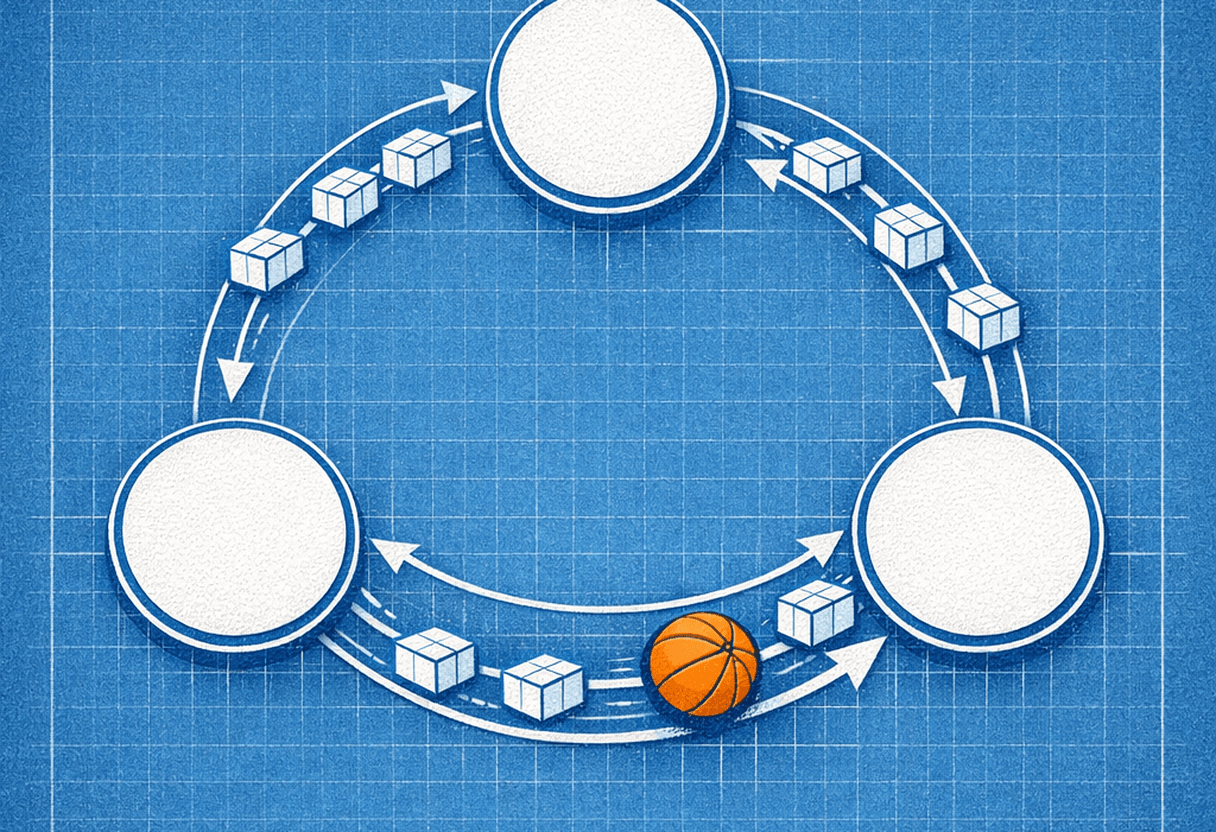
In a multi-team trade, every participant must independently satisfy its own salary-matching rules based on its own payroll position. A team under the cap absorbs salary into space. A team over the first apron matches dollar for dollar. A second-apron team sends out exactly one contract. The deal is legal only if each side clears its own test simultaneously.
Adding a third team is how front offices route around a blockage. One team has the player, another has the picks, a third has the cap space or the trade exception needed to make the salary work. None of them could complete the deal in pairs; together they can. The third team is often participating purely as a facilitator, absorbing an awkward contract in exchange for a second-round pick and someone else's problem.
There is one quirk worth knowing. In a multi-team trade, each team must "touch" at least two of the others, meaning it has to send something to more than one participant. The something can be almost nothing: a top-55 protected second-round pick, the draft rights to a player who will never come over from Europe, or the league-minimum $110,000 in cash. Those absurd-looking filler pieces in a three-team trade are not accounting noise. They are there because the rulebook requires each team to be genuinely connected to two others, and a token asset is the cheapest way to satisfy it.
Who Cannot Be Traded, and When
Even when the money works, individual players are frequently locked.
- The December 15 rule. A free agent who signs a new contract generally cannot be traded for three months or until December 15, whichever comes later. This is why the trade market is nearly frozen in the season's opening weeks and abruptly wakes up in mid-December.
- The January 15 restriction. A player who re-signed with his previous team on a raise of at least 20%, above the minimum salary, using Bird or Early Bird rights while his team was over the cap, must wait until January 15 instead.
- Extensions. A player who signs an extension or has his contract renegotiated can face a six-month restriction from the date the deal was executed.
- The implicit no-trade clause. A player who re-signs with his own team on a one-year deal, or a two-year deal where the second year is an option, gains the right to veto any trade during that season. He did not negotiate for it; the CBA grants it automatically.
- Negotiated no-trade clauses. These are genuinely rare. Very few players in league history have qualified for and secured one.
The Deadline
The trade deadline arrives in early February, and it is a hard stop. After it passes, rosters can only be changed through the buyout market and G League call-ups for the remainder of the season, which is why the deadline concentrates so much activity into a few hours.
The apron rules have changed the character of deadline day considerably. The teams with the most obvious needs, the expensive contenders, are precisely the teams with the fewest legal tools. Meanwhile teams in the middle of the payroll table, with matching flexibility and tradable picks, have become the market's most important participants.
Why Most Rumored Trades Never Happen
Run a rumored deal through the checklist and the failure points are usually structural rather than philosophical.
Does the salary match under the correct tier for each team's payroll? Is either team over the second apron, and if so, is it trying to combine two contracts? Are the picks involved actually tradable under the Stepien rule, or is one of them frozen? Has the player in question passed his December 15 or January 15 date? Did he re-sign on a one-year deal and quietly acquire veto power?
A trade has to clear every one of these to be filed with the league office. Most proposed deals fail at least one, and the ones that fail are rarely the ones that were unreasonable on talent. The modern CBA has made roster construction into a genuine constraint-satisfaction problem, and the front offices that win at it are the ones that understood the constraints first.

Related Reading
- The NBA Salary Cap Explained: Tax and Aprons
- How the NBA Draft Lottery Works: Odds and Rules
- The Most Traded Players in NBA History
- NBA Players Who Won Titles With Multiple Teams
The transfer market in Career Mode runs on the same logic: every deal needs the other side to accept, and the terms have to work for both. Test your trade-history recall with our daily Higher or Lower quiz.