
The NBA draft lottery is the most consequential 90 seconds in league operations, and almost nobody can explain what actually happens inside it. Fourteen ping-pong balls go into a machine in a sealed room. Four come out. A franchise's next decade gets decided by a combination of numbers that nobody in the broadcast studio ever sees drawn. The system has been rebuilt twice, most recently in 2019, specifically to punish the teams that lose on purpose - and the reform worked well enough that the league's worst record is now far more likely to pick fifth than first. Here is the whole machine: the odds, the drawing, the rule changes, and the long shots that made all of it feel rigged.
Why the Lottery Exists at All
Before 1985, the first overall pick was decided by a coin flip between the worst team in each conference. That is not a system with a tanking problem; that is a system that is entirely a tanking problem. Two teams, one flip, and every other non-playoff club playing for nothing. Losing games in March was the single highest-leverage action a bad front office could take.
So the NBA scrapped it. In 1985 the league introduced a lottery in which every non-playoff team was entered with an equal chance at the top pick. Equal chance is the key phrase: the 1985 format gave the 11th-worst team exactly the same odds as the worst, which killed the incentive to lose outright. It also created a new problem, which is that a team could be genuinely terrible for three straight years and never once move up.
Every version of the lottery since has been an attempt to find the balance between those two failure modes. Reward the bad teams too much and you incentivize tanking. Reward them too little and you strand the franchises that actually need help.
The Frozen Envelope
The first lottery is also the source of the league's most durable conspiracy theory. The New York Knicks won it and took Georgetown's Patrick Ewing, the most hyped center prospect since Kareem Abdul-Jabbar, and the league's marquee franchise landing the marquee prospect in the first year of a brand-new system struck a lot of people as convenient.
The theory holds that the Knicks' envelope was chilled in a freezer so commissioner David Stern could identify it by touch, or that a corner was creased so he could spot it. It has never been substantiated, and the likeliest explanations are mundane: envelopes get dinged when they are tossed into a drum on live television. But "the frozen envelope" entered the language permanently, and it is the reason the modern drawing happens in a sealed room with team representatives, auditors, and a rigidly documented procedure. The NBA's answer to a conspiracy theory was to make the process boring and observed.
How the Drawing Actually Works
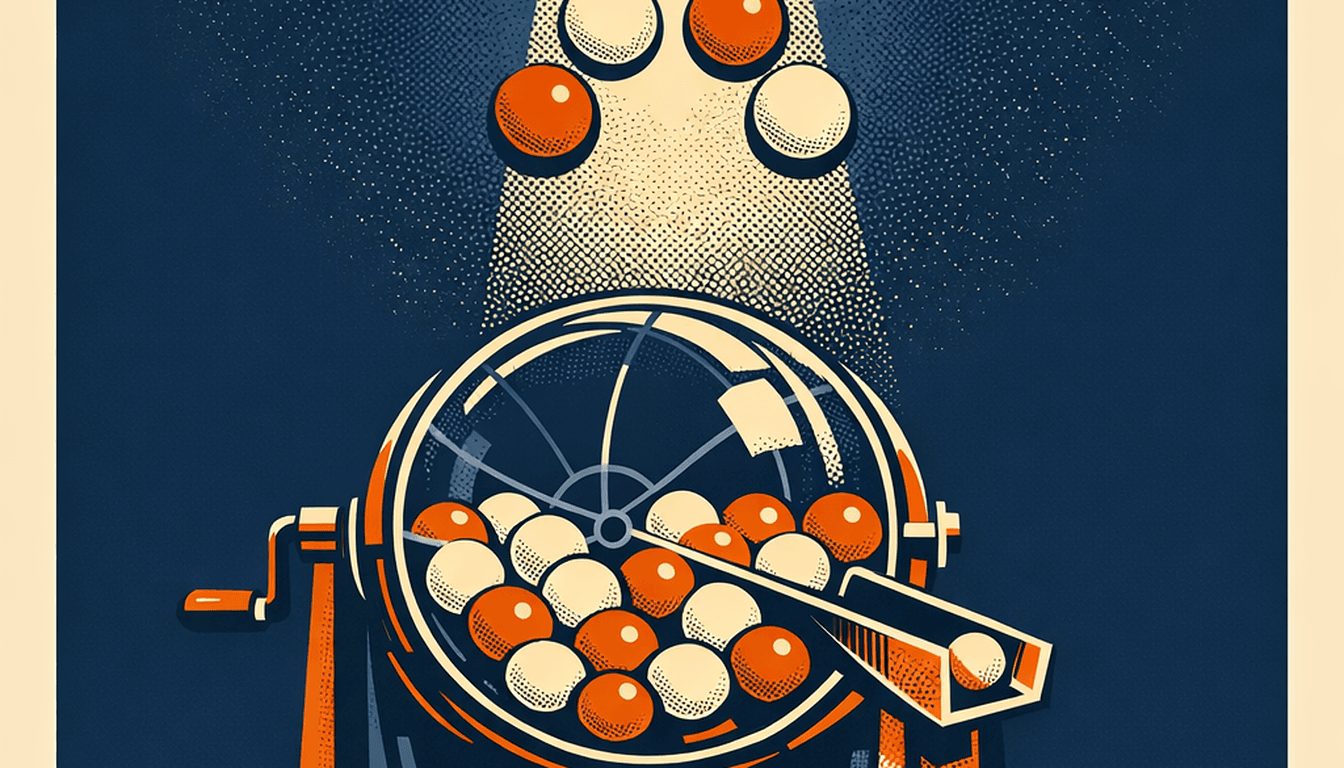
Fourteen ping-pong balls, numbered 1 through 14, go into a machine. Four are drawn. Drawing four balls from fourteen without regard to order produces exactly 1,001 possible combinations, and the league assigns 1,000 of them to the 14 lottery teams. The 1,001st combination is a designated do-over: if it comes up, the balls go back in and the draw is repeated.
The mechanics are timed to the second. All 14 balls are mixed for 20 seconds before the first is drawn. The remaining balls are mixed for another 10 seconds before the second, another 10 before the third, and a final 10 before the fourth. Whichever team holds that four-number combination wins the pick. The balls go back in the machine and the entire process repeats for the second pick, then the third, then the fourth.
That is the part worth internalizing: the lottery is not one draw that produces a whole order. It is four separate draws, each one a fresh pull from the same 14 balls, with already-selected teams removed from contention.
The Odds, Team by Team
Since 2019 the three worst teams in the league share identical odds at the top pick: 14% each. From there the odds step down about a point and a half at a time - 12.5%, 10.5%, 9%, and onward - until the 14th team, the best of the non-playoff clubs, sits at 0.5%.
Those numbers describe the chance of winning the number one pick specifically. Because four picks are drawn, every team's odds of landing somewhere in the top four are meaningfully better than its odds of landing first. A team at 14% for the top pick has a little over half a chance of coming away with a top-four selection.
Only Four Picks Are Drawn
This is the rule that decides more lottery nights than the odds do. The machine determines picks one through four and nothing else. Picks five through 14 are then filled in by inverse regular-season record: the worst remaining team gets the fifth pick, the next-worst gets the sixth, and so on down the board.
The consequence is a hard floor and a brutal ceiling. The team with the worst record in the league cannot fall below fifth, because at most four other teams can jump ahead of it. But that same team's single most likely outcome is precisely that fall: under the current odds, the worst record in the NBA has a 47.9% chance of ending up with the fifth pick. Nearly half the time, the reward for having the league's worst season is the fifth-best prospect.
Protected Picks and Why Lottery Night Decides Trades
Lottery night does not just assign prospects. It settles debts, because a large share of the picks in the room already belong to somebody else, and most of those come with conditions attached.
A traded pick is usually protected, meaning it only changes hands if it lands outside an agreed range. A top-4 protected pick stays with the original team if it lands anywhere in the first four slots and conveys to the new team at five or later. A lottery-protected pick stays home if it falls anywhere in the top 14. When a protected pick fails to convey, it does not simply vanish: the obligation rolls forward, typically with the protection shrinking each year until the pick becomes unprotected and has to be handed over.
This is why front-office staffers watch the drawing with more anxiety than fans do. A single ball can move a pick across a protection threshold and, with it, move a franchise's entire asset sheet. A team sitting at number five with a top-4 protected pick owes that selection to a rival; the same team jumping to number four keeps it outright and pushes the debt into next season. Nothing about the roster changed. The obligation flipped on one combination.
The rollover mechanic also explains why some rebuilds feel like they are running in place. A club can spend three consecutive seasons in the lottery, land in the protected range each time, and keep every one of its own picks while an old trade obligation quietly compounds behind it. The bill still arrives, and it usually arrives unprotected, in the season the team finally expects to be good.
For anyone trying to read a rebuild from the outside, the protections tell you more than the record does. They reveal what the previous regime mortgaged, how long the current one has before it comes due, and whether a surprisingly bad season is a disaster or a windfall.
The 2019 Reform That Changed the Math
The current structure exists because the old one was too generous to the bottom. Before 2019, the worst team held a 25% chance at the top pick, the second-worst 19.9%, and the third-worst 15.6%. Only the top three picks were drawn rather than the top four.
Run those numbers out and the old system gave the league's bottom three a combined 60.5% chance of landing the first overall pick. Teams seeded fifth through 14th - the ones that were bad but not deliberately dreadful - split a 27.6% chance between them.
The reform inverted that relationship. Today the bottom three have a combined 42.0% chance at the top pick, while teams five through 14 hold 45.5%. For the first time in the lottery era, the mid-lottery is collectively more likely to win the top pick than the tanking tier. Adding a fourth drawn pick compounded the effect, because it created one more slot for a long shot to leap into and one more way for a bottom team to get pushed down.

When the Long Shots Hit
The lottery's reputation is built on the nights the math broke.
Orlando, 1993. The Magic entered with the worst odds in the field at 1.52% and won, jumping from 11th to first and becoming the first franchise to win back-to-back lotteries. They had taken Shaquille O'Neal first overall the year before. What they did with the second one is the best part: Orlando drafted Chris Webber at number one, then traded him to Golden State minutes later for the third pick, Penny Hardaway, plus three future Warriors first-rounders. Webber won Rookie of the Year and Hardaway finished runner-up, but Hardaway and O'Neal took the Magic to the Finals in their second season together.
Chicago, 2008. The Bulls finished 33-49, ninth in the lottery order, with a 1.7% chance at the top pick. They won it and drafted Derrick Rose, a Chicago native who would become the youngest MVP in league history three seasons later. It remains one of the largest leaps the lottery has ever produced.
New Orleans, 2019. The Pelicans tied for the seventh-worst record at 33-49 and came in with 6% odds. They won, took Zion Williamson, and did it in the very first year of the flattened format - a result that functioned as an immediate advertisement for the reform the league had just passed.
The 2026 Lottery
The most recent drawing was a rare case of the odds behaving. The Washington Wizards, Indiana Pacers, and Brooklyn Nets finished with the three worst records of the 2025-26 season and entered tied at 14%. Washington won it, and the top four came out Wizards, Jazz, Grizzlies, Bulls.
The Wizards used the pick on BYU forward AJ Dybantsa. It was the first time in a while that the team with a share of the best odds actually converted them, and it is a useful reminder that "the favorite" in a lottery is a team with an 86% chance of not winning.
Why Tanking Stopped Paying Off
Put the pieces together and the modern lottery is a deliberately bad deal for the worst team in the league.
Bottoming out buys you a 14% shot at the top pick, a slightly better than even chance at a top-four pick, and a 47.9% likelihood of picking fifth. You cannot improve those odds by being worse than the other two bottom teams, because all three are pinned at the same 14%. The marginal loss in March, the one that drops you from second-worst to worst, now buys literally nothing.
That is the reform working exactly as designed. It did not eliminate tanking, because a rebuilding team still wants the higher floor that comes with a bad record, and the fifth pick is genuinely better than the 15th. What it eliminated was the race to the bottom, the specific incentive to be worse than the other bad teams. The three-way tie at the top of the odds board is the whole mechanism, and it is why the tanking conversation has shifted from "who will finish last" to "who is closest to actually being good."
Related Reading
- The Biggest Busts in NBA History
- NBA Draft Trivia: Surprising Facts About Draft Night
- The Best Undrafted Players in NBA History
- NBA Rookies Who Changed the Game Immediately
Understanding the lottery is understanding that a franchise's best-laid plan can be undone by four ping-pong balls, which is roughly the feeling of running a team in Career Mode. Test your draft-night recall with our daily Higher or Lower quiz.