
If you searched "possession play" and landed here, there are two games with that name and they share one idea. The first is Possession Play, the football hex game at playfootball.games: a 31-hex board, two players taking turns naming footballers who fit a category, and a steal rule that turns one good answer into a swing of three or four hexes. The second is the NBA version on airball.gg, also called Possession Play, which took the same board and the same steal and swapped the football categories for NBA teams, awards and career milestones. This guide explains how the football original plays, exactly as its own rules page describes it, what its four modes are, why the steal is the whole game, and how the NBA board differs - the clock, the categories, the once-per-match rule and the ranked ladder.
What Is Possession Play?
Possession Play is the multiplayer hex game on Play Football Games, the site at playfootball.games that describes itself as free online football games and quizzes updated every day. It is one of the two games that site marks as multiplayer rather than daily. The page's own title is "Possession Play - Football Hex Game", and its description is as short as the game is: play with a friend online or on the same screen.
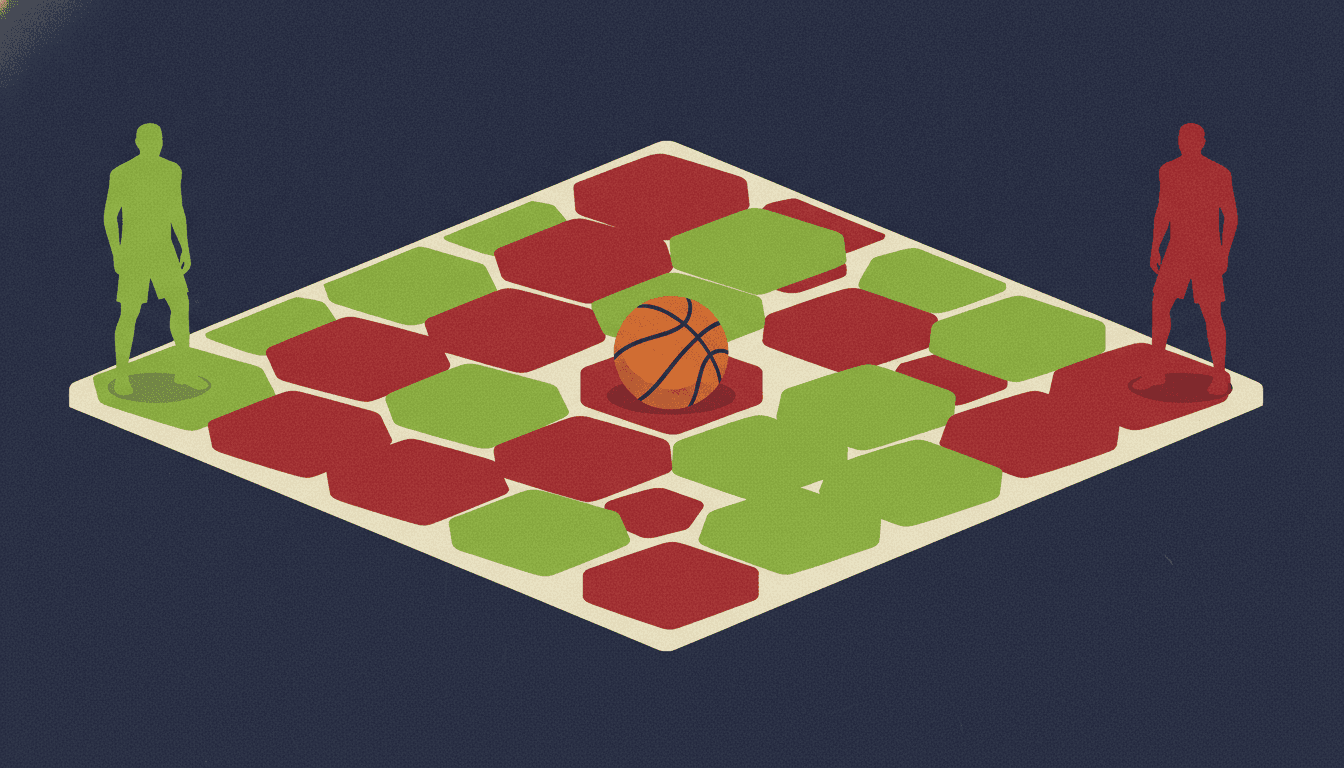
The board is a honeycomb of 31 hexes. Each hex carries a football category, the kind the site's other games use: a club such as Arsenal or Ajax, a nation such as Argentina or Nigeria, an honour such as "LaLiga winner" or "Won Copa America", or a career fact such as "Played in 3+ Big 5 Lges". Two players take turns. The winner is whoever owns more hexes when the board is full.
How a Game of Possession Play Works
The rules page is three sentences long, and all three matter. Take turns selecting a neutral hex and naming a player who fits that category. If your answer also matches any touching hex, you claim those too, and you can steal them from your opponent. When all 31 hexes are claimed, the player with more hexes wins.
The second sentence is the game. A footballer who played for two clubs on neighbouring hexes claims both in one move, and if one of those hexes already belonged to your opponent, it changes hands. So a turn is never just "name someone who played for Chelsea". It is "name someone who played for Chelsea and also satisfies the Euros-winner hex above it and the Belgian-league hex to the left" - and if your opponent took the Euros hex two turns ago, that one answer takes it back.
The clock is a chess clock. Each player has their own timer, and it runs only on your turn. Dither on your move and you burn your own time; your opponent's clock stays still. That is a different pressure from a per-turn countdown.
The Four Ways to Play, and The Heatmap
The lobby offers four doors. "With a friend" sets up a private online room you share with someone. "Online opponent" pairs you with another football fan online. "Same screen" is two people on one device, taking turns. The fourth door, "Single player", does not open a bot match - it sends you to The Heatmap, the site's daily single-player hex game that uses the same board idea with a scoring twist.
The Heatmap is worth knowing because it shows what a one-player hex game looks like. You pick any unclaimed hex, enter a player who matches, and a valid player also checks the touching hexes, claiming every neighbouring category they fit in the same move. New cells score as a combo: one cell is 1 point, two cells are 3, three are 6, four are 10, and so on. Already-claimed touching cells can still count if your player matches them: they add 1 point each and make the board "hotter". Fill every playable hex to finish, and Heat Density reports the average heat across your final board.
Why the Steal Is the Whole Game
Strip the hex game down and it is a category-matching quiz with a geometry attached. The geometry is what makes it a game rather than a test. On a 31-hex honeycomb, an interior hex touches six neighbours, an edge hex touches fewer, and a corner touches fewest. Every answer has a blast radius, and the best answers are the players whose careers wandered through the most categories that sit next to each other on today's board.
Three consequences follow, and they hold in the football game and the NBA one alike. Central hexes are worth more than edge hexes, because the same player claims more ground there. A player who fits five categories is worth more than a legend who fits one. And what your opponent just claimed is the first thing to look at, because taking is faster than filling: a hex you steal is a two-point swing, one off their count and one onto yours, while an empty hex is only one.
The NBA Version: Possession on airball.gg
Possession Play on airball.gg keeps the honeycomb and the steal and changes the sport. The board is 31 hexes, each carrying an NBA category: a team, an award, a career milestone. You take turns claiming them by naming a player who fits, and your player also claims every adjacent hex they qualify for, including hexes your opponent already owns. Most claims wins.
Every category is checked against the same verified player database that runs the rest of airball.gg's games, so a correct answer is never a matter of opinion: either the record says a player wore that jersey or won that award, or it does not. Each player can be named once per match, by either side, so the pool of flexible multi-category names shrinks as the game goes on.
There are three ways to play. A bot match is open to anyone, as many times as you like, with nothing on the line. A friend match generates an invite link; whoever opens it joins your board and the match runs live for both of you. A ranked match needs both players signed in, because it moves your rating and the Possession leaderboard - and a friend match can be ticked ranked if you both want it to count.
How the NBA Board Differs From the Football One
The first difference is the clock. The football game runs a chess clock, where your timer runs only on your turn. The NBA game runs a per-turn countdown of 30 seconds. If it hits zero you forfeit that turn and play passes over, so a safe claim beats a perfect one you cannot find in time.
The second is what the categories are. Football categories lean on clubs, nations and competitions, with regional groupings such as the Balkans and spells in particular leagues. The NBA board's three families are franchises, awards and career milestones: the kind of facts that make a journeyman with a Sixth Man of the Year trophy more valuable than a one-team MVP, as the worked turn below shows.
The third is the ladder. The NBA version has a bot opponent for practice, which the football lobby does not offer on the Possession Play page itself, and a ranked mode with a rating and a leaderboard that need an account on both sides. Casual and friend matches need nothing.
The fourth: a player can be used once per match. Once either side has named someone, that name is spent.
Strategy: Play the Middle, Spend Journeymen, Bank a Flexible Name
Play the middle first. Central hexes touch the most neighbours, so one name claims more ground there than on the edge, and edge hexes are much harder for your opponent to steal back later because fewer hexes touch them.
Journeymen are worth more than superstars. A player who fits five categories is a five-hex swing; a one-team legend who satisfies one hex is a wasted turn, however famous. This inverts the usual trivia hierarchy: the best Possession players are the ones who remember that a particular forward spent half a season somewhere nobody else recalls.
Look at what your opponent just claimed before you look at what is empty. Naming a player who fits their cluster steals those hexes outright. The fastest way to swing a match is taking, not filling.
Spend your flexible names late. Because each player can only be used once, the obvious multi-category stars vanish early. Bank one or two for the endgame when the board is tight and every hex is contested.
And watch the clock. If nothing comes, claim any safe hex rather than losing the turn.
A Worked Turn: One Name, Three Hexes
Picture a cluster of three touching hexes: "Sixth Man of the Year", "Philadelphia 76ers" and "Los Angeles Clippers". Your opponent took the 76ers hex a turn ago. You name Lou Williams. He is a three-time Sixth Man of the Year, he was drafted 45th overall in 2005 by Philadelphia straight out of high school, and he played for the Clippers. All three hexes are yours, and the 76ers hex came off your opponent's count. One answer, a three-hex gain and a one-hex steal.
The purest version of that player is Ish Smith, who holds the NBA record for most franchises played for, at 13. He broke the mark of 12 that Chucky Brown, Jim Jackson, Tony Massenburg and Joe Smith had shared, and his thirteenth stop, the 2022-23 Denver Nuggets, is the one that ended in a championship. On a board where several of the 31 hexes are teams, a name like that is a weapon - which is also why you do not spend it in the first three turns.
Jeff Green is the same shape of answer with a different flavour: a career that ran through more than ten franchises and a first title that arrived with the 2023 Nuggets, so he answers both a stack of team hexes and a "won a championship" milestone.
Where Possession-Style Games Fall Short
Both versions have the same honest limitation: they need an opponent, or at least a bot, and a match takes real time. That makes them a worse fit for the thirty-second daily habit that a Wordle-style game builds, and a better fit for a group chat or a couch. The football game's single-player door leads to a different game entirely; the NBA version's bot match fills that gap, but a bot is not a rival.
The clock cuts both ways. A chess clock rewards patience and punishes dithering on your own time; a per-turn countdown keeps the match moving but can end a careful turn before the answer arrives.
And the steal, the thing that makes the game, can feel brutal the first time it happens to you. A hex you earned with a good answer is gone because your opponent found a better one. That is the design, and it is the reason a 31-hex match rarely ends 16-15 by accident.
Games Like Possession Play
If what you like about the hex game is the category matching rather than the duel, the daily grid games are the closest cousins. They cross a row with a column and ask for one player who satisfies both, which is the hex game's adjacency rule flattened into a grid you can play alone in five minutes. airball.gg's version is Hoop Grid, covered in the next section.
If you like the pressure of naming players against a clock, Shot Clock on airball.gg asks you to name as many players as you can who fit one category in 100 seconds, and Bingo turns a card of categories into a race to a line. If you like the once-per-player constraint, Connections and 2 Truths 1 Lie both reward the same journeyman memory from a different angle. All of them reset daily, so they build the habit the duel game cannot.
Hoop Grid: The Solo Daily Version
Hoop Grid is a 3x3 grid where every cell crosses a row with a column. The three rows are NBA teams; the columns are one more team, an award category and a career-stat category. Tap a cell and search for a player who satisfies both conditions - for a team-team cell that means someone who played for both franchises, for a team-award cell someone who played for that team and won that award at any point in their career. You get nine guesses in total, every guess counts whether it lands or bricks, and each player can only be used once per board. Fill six or more cells and the day is a win.
What makes it more than a quiz is the rarity score. Each filled cell scores the percentage of today's players who made the same pick, so a pick 40 percent of people made costs 40 and a pick nobody else made, a unicorn, costs almost nothing. The lower your total the better. It is the same journeyman instinct the hex game rewards, measured against everyone else playing that day instead of one opponent across the board.
Why Category Games Reward the Journeyman Memory
Every game in this guide, the football one and the NBA one, the duel and the daily grid, runs on the same engine: a database of who played where and what they won, and a rule that makes the player who fits the most categories the most valuable answer on the board. It is about the forward who was on five rosters in six seasons, the guard who won an award with a team you forgot he played for, the record-holder whose record is that he was traded more than anyone.
Learn that corner of the game and both versions of Possession Play open up. Start in the centre, read the board for steals, and keep one flexible name in your pocket for the last three hexes.

Related Reading
- NBA Grid Game: How to Play the Daily Basketball Grid
- Best NBA Trivia Games to Play Online in 2026
- The Most Traded Players in NBA History
- 20 Most Underrated NBA Players of All Time
Claim a hex board yourself: Possession is head-to-head, open to everyone, and the same journeyman memory pays off every day in our Hoop Grid quiz.