
Offense gets the highlights, but defense wins championships. The greatest defenders in NBA history didn't just stop their man - they changed how opponents ran their entire offense, forced coaches to redraw the playbook, and turned games that should have been close into 14-point losses the box score never explained. Below is a tour through the players who defined defensive excellence, the awards that catalogued them, and the rule changes that quietly rewrote what "great defense" even means.
How the NBA Has Defined Defense - and Kept Changing the Definition
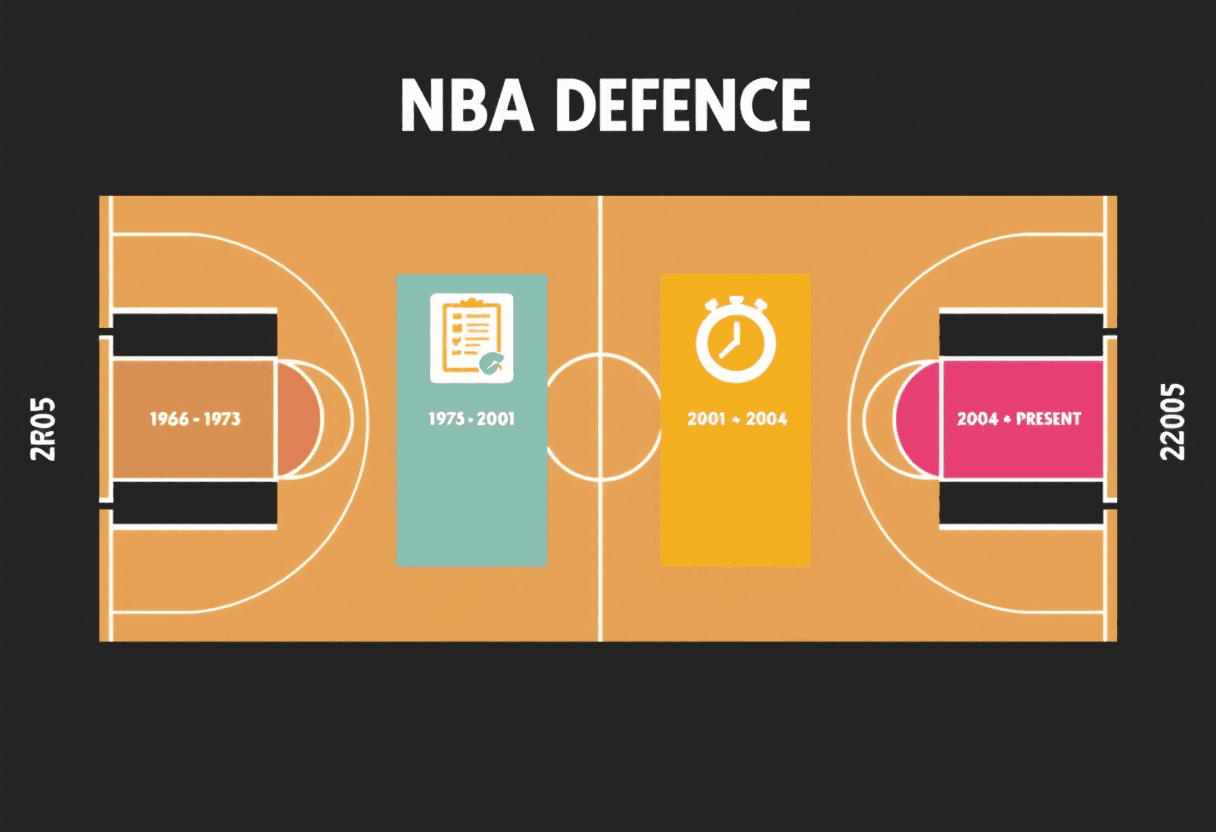
You can't honestly compare Bill Russell to Rudy Gobert without acknowledging they played in two different sports. The NBA has rewritten its defensive rulebook multiple times, and every rewrite reshaped which skills won.
The block and steal blackout (pre-1973-74). The NBA didn't track blocks or steals until 1973-74. That single fact is why Bill Russell's career stat line is mostly rebounds - his shot-blocking, the skill that anchored 11 championships, never made it into a box score.
The illegal defense era (1947-2001). For more than five decades, the NBA outlawed zone defenses outright. A defender had to be assigned to a man, and the pairing was policed by referees calling "illegal defense" technicals. This is why the great defenders of the 80s and 90s - Moncrief, Jordan, Payton, Pippen - were almost all one-on-one stoppers. Help defense was constrained by rule, not just by personnel.
Zone legalization and defensive three-second (2001-02). The league scrapped illegal defense and legalized zones. To prevent centers from camping in the paint, it simultaneously introduced the defensive three-second violation: a defender not actively guarding a man can't park in the lane for more than three seconds. The combination invented modern team defense - switching, tagging, weak-side help - that Tim Duncan and Kevin Garnett would master.
The handcheck ban (2004-05). The most consequential defensive rule change in modern NBA history. The handcheck rule had let defenders ride ball-handlers with hands and forearms on hips and chest. After 2004-05 banned it, scoring jumped roughly four points per game almost overnight, and the position of "lockdown perimeter defender" became immensely harder. Gary Payton has joked he was the reason the league banned it.
Reading the list below requires keeping all four eras in mind. A player elite under one set of rules might not even be eligible to play the same role under another.
Bill Russell - The Original Defensive Anchor
Bill Russell didn't just play defense - he invented shot-blocking as a strategy. Before Russell, blocks were rare and mostly accidental. He turned them into an art form, using timing and positioning to reject shots while keeping the ball in play, turning a stop into a transition opportunity. He averaged 22.5 rebounds per game, led the league in rebounding four times, and is still second all-time in total rebounds and rebounds per game.
Russell's 11 championships - eight straight from 1959 through 1966 - are the ultimate testament to defensive impact, and he won five MVPs in an era that didn't reward defenders. The DPOY award didn't exist in his time (it was first awarded in 1982-83, 14 years after Russell retired), which is part of why younger fans underrate him.
Hakeem Olajuwon - The Complete Defender
Hakeem Olajuwon is the only player to win MVP, Defensive Player of the Year, and Finals MVP in the same season (1993-94). It's the most complete two-way season in NBA history, and no one has come close to repeating it. He holds the NBA's all-time record for career blocks (3,830) and is the only player ever to record more than 3,000 blocks and 2,000 steals. He led Houston to back-to-back titles in 1994 and 1995, won Finals MVP both years, and outscored a young Shaquille O'Neal in every game of the 1995 Finals sweep.
What made Hakeem special was his footwork. He defended the post with power, switched onto guards on the perimeter, and recovered on plays most big men would have abandoned. He's the prototype for the modern switchable center - except he was doing it in 1994 against teams that hadn't yet been allowed to run zone or modern help defense. He won DPOY in 1992-93 and 1993-94, and the award is now named the Hakeem Olajuwon Trophy.
Ben Wallace - Undrafted to Defensive Dominance
Ben Wallace was undrafted in 1996 and became a four-time Defensive Player of the Year (2001-02, 2002-03, 2004-05, 2005-06). Listed at 6'9" - and by his own admission closer to 6'7" - he was deeply undersized for a center but played with an intensity that made him one of the most feared defenders in NBA history. In 2002 he became one of just four players (alongside Kareem, Bill Walton, and Hakeem) to lead the league in both rebounding and blocks in the same season.
Wallace anchored the 2004 Pistons' championship defense, which held the Shaq-Kobe Lakers under 90 points three times in the Finals on the way to a 4-1 series win virtually no one predicted. He was inducted into the Hall of Fame in 2021 - the first undrafted player ever to reach Springfield.
Gary Payton - The Glove
Gary Payton earned "The Glove" for his suffocating perimeter defense. He won Defensive Player of the Year in 1995-96 and remained the only point guard to win the award for 26 years, until Marcus Smart broke the drought in 2022. Payton didn't just stay in front of his man - he denied the ball, talked trash constantly, and exhausted opponents before they ever caught it.
Payton was named to nine consecutive All-Defensive First Teams from 1994 to 2002, tying the all-time record for First Team selections shared with Michael Jordan, Kevin Garnett, and Kobe Bryant. His defense on Michael Jordan in the 1996 Finals is legendary: after Seattle fell behind 3-0, Payton's full-court pressure on Jordan helped the Sonics win Games 4 and 5 before ultimately falling in Game 6. He's also the patron saint of every defender who lost their best weapon in 2004 - the Glove era simply could not exist in its 1990s form without handchecking.
Scottie Pippen - The Versatile Defender
Scottie Pippen could guard positions 1 through 4 at an elite level - a one-man scheme in a league that hadn't yet legalized modern help defense. His combination of length (6'8"), athleticism, and basketball IQ made him the ultimate defensive Swiss Army knife. Pippen was named to the All-Defensive First Team eight times and the Second Team twice, for ten total selections.
In the Bulls dynasty, Pippen typically guarded the opposing team's best offensive player regardless of position - point guards in Game 1, power forwards in Game 7 - allowing Michael Jordan to conserve energy and focus on scoring. The partnership between Jordan's scoring and Pippen's defensive versatility was the foundation of every championship Chicago won, and Pippen's defensive role is consistently undervalued in retrospective rankings.
Dikembe Mutombo - The Shot Blocker
Dikembe Mutombo's finger wag after blocking a shot is one of the most iconic gestures in NBA history. The 7'2" center won four Defensive Player of the Year awards - 1995 with Denver, 1997 and 1998 with Atlanta, and 2001 with Philadelphia - tying the all-time record now shared by Mutombo, Wallace, and Gobert. He led the league in blocks three times.
Mutombo's most famous moment came in the 1994 playoffs, when his eighth-seeded Nuggets upset the first-seeded SuperSonics - the first 8-over-1 upset in NBA history under the five-game format. He won DPOYs with three different franchises, which speaks to the portability of his defensive value: he wasn't a system player, he was the system.
Kawhi Leonard - The Modern Lockdown
Kawhi Leonard's defensive impact is measured in how completely he can erase an opposing star. His hands are legendary - 9.75 inches long, 11.25 inches wide, almost identical to Michael Jordan's measurements. He strips the ball from players who think they have a secure dribble, and his combination of length and hand size makes passing lanes look smaller against him than against anyone else.
Leonard won back-to-back DPOYs in 2014-15 and 2015-16, becoming the first non-center to win consecutive awards since Dennis Rodman in 1989-90 and 1990-91. He used that defense as the foundation for two Finals MVPs - 2014 with San Antonio and 2019 with Toronto - and his work on LeBron James in the 2014 Finals flipped the trajectory of both franchises.
Rudy Gobert - The Modern Rim Protector
Rudy Gobert has won four Defensive Player of the Year awards (2017-18, 2018-19, 2020-21, 2023-24), tying the record held by Mutombo and Wallace. The 7'1" French center's impact is measured in how dramatically he changes opponent behavior - players simply avoid driving when Gobert is there, and the shots they do take at the rim convert at a rate 10-15 percentage points lower than average.
Gobert is the most divisive name on this list. Critics argue he's been carved up in playoff matchups by smaller switching offenses that pull him from the paint. Defenders point out he's the only modern player whose anchor presence shows up as a top-three differentiator in nearly every advanced defensive metric. He's the statistical embodiment of defensive impact in the post-handcheck, zone-legal era.
DPOY History - The Multi-Time Winners
The Defensive Player of the Year award was first given out for the 1982-83 season. Sidney Moncrief of the Bucks was the inaugural winner and repeated in 1984. Here's how the four-time winners and other repeat champions stack up:
| Player | DPOY Wins | Years | |---|---|---| | Dikembe Mutombo | 4 | 1995, 1997, 1998, 2001 | | Ben Wallace | 4 | 2002, 2003, 2005, 2006 | | Rudy Gobert | 4 | 2018, 2019, 2021, 2024 | | Dwight Howard | 3 | 2009, 2010, 2011 (consecutive) | | Sidney Moncrief | 2 | 1983, 1984 | | Mark Eaton | 2 | 1985, 1989 | | Dennis Rodman | 2 | 1990, 1991 | | Hakeem Olajuwon | 2 | 1993, 1994 | | Alonzo Mourning | 2 | 1999, 2000 | | Kawhi Leonard | 2 | 2015, 2016 |
Dwight Howard's three-peat in Orlando from 2009 through 2011 is the only time anyone has won DPOY in three consecutive seasons - a streak none of the four-time winners ever stitched together.
DPOY by Position - Why Guards Almost Never Win
Only five guards have ever won DPOY: Sidney Moncrief (twice), Michael Jordan (1988), Alvin Robertson (1986), Gary Payton (1996), and Marcus Smart (2022). The award is structurally biased toward rim protectors - blocks and rebounds show up in box scores while ball-pressure and rotational discipline don't. The Marcus Smart win in 2022 broke a 26-year guard drought after Payton.
The Single-Season Shot-Blocking Records
Two names dominate the per-game leaderboards:
| Player | Single-Season BPG | Year | |---|---|---| | Mark Eaton | 5.56 | 1984-85 | | Manute Bol | 5.0 | 1985-86 | | Hakeem Olajuwon | 4.59 | 1989-90 | | Mark Eaton | 4.61 | 1983-84 | | Manute Bol | 4.31 | 1988-89 |
Mark Eaton's 5.56 blocks per game in 1984-85 is the gold standard - more than double the league's second-best shot-blocker that year (Hakeem at 2.68). Eaton was a two-time DPOY (1985, 1989) and holds the career record for blocks per game at 3.5. Manute Bol's 5.0 as a rookie in 1985-86 is the only other 5-block season. Neither will likely be approached - the modern game has fewer post-ups, more pull-up threes, and more switching, all of which shrink the at-the-rim shot diet a great shot-blocker needs.
Position-by-Position All-Time Defense
Who anchors an all-time defense by position if we treat every era on equal footing?
Point Guard. Gary Payton is the consensus pick - only PG with a DPOY for 26 years, nine consecutive All-Defensive First Teams. Jason Kidd's 2,684 career steals (third all-time) and four All-Defensive First Team selections make him the next name. Sidney Moncrief, Dennis Johnson, and Marcus Smart round out the shortlist.
Shooting Guard. Michael Jordan - nine All-Defensive First Team selections and the 1988 DPOY. Kobe Bryant matches Jordan's nine First Team selections. Dennis Johnson and Tony Allen (three All-Defensive First Teams as a Grizzly) belong in the conversation.
Small Forward. Scottie Pippen and Kawhi Leonard are the heavyweights. Pippen's 10 All-Defensive selections (eight First Team) and Kawhi's two DPOYs are the resume points. Bobby Jones - "The Secretary of Defense" - earned eight All-Defensive selections and is the historical pick younger fans miss. Ron Artest / Metta World Peace won DPOY in 2003-04 as a point-of-attack stopper just before the handcheck ban.
Power Forward. Tim Duncan holds the all-time record for All-Defensive Team selections with 15, somehow never won a DPOY, and is the most famous omission in award history. Kevin Garnett won DPOY in 2007-08 and tied the all-time record for All-Defensive First Team selections with nine. Dennis Rodman's two DPOYs and seven All-Defensive First Teams make him a top-three PF defender by any honest accounting.
Center. The Mount Rushmore: Russell, Hakeem, Mutombo, and either Ben Wallace or Rudy Gobert. David Robinson (1992 DPOY) and Alonzo Mourning (back-to-back DPOYs in 1999 and 2000) belong in the discussion. Mark Eaton's two DPOYs and his per-game blocks records are the most overlooked center resume.
What Advanced Stats Tell Us That Boxscores Don't
A great defender and a great defensive stats player are not always the same person. Andre Drummond led the league in total rebounds five times but graded as a roughly average defender by impact metrics - his counting numbers came from uncontested boards rather than altering opponent looks. Manu Ginobili rarely finished near the top of any traditional defensive leaderboard but graded as an elite team defender by every advanced metric throughout his prime. DBPM, defensive RAPM, and defensive estimated plus-minus reward the things that don't show up in a box score - staying attached on screens, tagging the roller, closing out short. Tracking data, league-wide since 2013, has confirmed what coaches always suspected: great team defenders create stops they don't get personal credit for.
The Hypothetical All-Time All-Defensive First Team
Build the all-time team using all four eras and the data we have:
- PG: Gary Payton. Only point guard with a DPOY for 26 years and the iconic 1996 Finals tape.
- SG: Michael Jordan. Nine All-Defensive First Teams and the 1988 DPOY.
- SF: Scottie Pippen. Ten All-Defensive selections and the defensive engine of a six-time champion.
- PF: Tim Duncan. Most All-Defensive selections all-time (15 in 19 seasons) and the most under-recognized DPOY snub on this list.
- C: Hakeem Olajuwon. Only player ever to win MVP, DPOY, and Finals MVP in the same season; all-time blocks leader.
Honorable mentions - Bill Russell (missing data), Kawhi Leonard, Kevin Garnett, Ben Wallace - could each be argued into the starting lineup without controversy.
The Defensive Stats Every Trivia Player Should Know
For trivia purposes, the headline numbers are:
- Career blocks leader: Hakeem Olajuwon (3,830)
- Career steals leader: John Stockton (3,265 - nearly 600 ahead of second place)
- Most DPOY awards: 4, tied - Mutombo, Wallace, Gobert
- Most consecutive DPOYs: 3, Dwight Howard (2009-2011)
- Single-season blocks record (per game): Mark Eaton, 5.56 in 1984-85
- Only player to win MVP + DPOY + Finals MVP same year: Hakeem Olajuwon, 1993-94
- Most All-Defensive Team selections: Tim Duncan, 15
- Most All-Defensive First Team selections: 9, tied - Michael Jordan, Gary Payton, Kobe Bryant, Kevin Garnett
- Only guards to win DPOY: Moncrief (1983, 1984), Robertson (1986), Jordan (1988), Payton (1996), Smart (2022)
Related Reading
- 20 Most Underrated NBA Players of All Time
- Every NBA Player to Win MVP and DPOY in the Same Season
- NBA Awards History: MVPs, DPOYs, and More
- Michael Jordan vs Tim Duncan: Comparing Two Different GOATs
- The Greatest Centers in NBA History
- The Greatest Point Guards in NBA History
- How to Build a Basketball Player That Wins
Defensive knowledge is a trivia differentiator - most fans default to scoring leaders and forget that the best player in a game is sometimes the one with two points and zero turnovers forced out of the opposing star. Knowing your DPOY winners, your All-Defensive First Team selections, and the gap between great defenders and great defensive stats players gives you an edge in Top 10 Quiz and Who Am I?, where the clues often hide on the defensive end of the floor.