
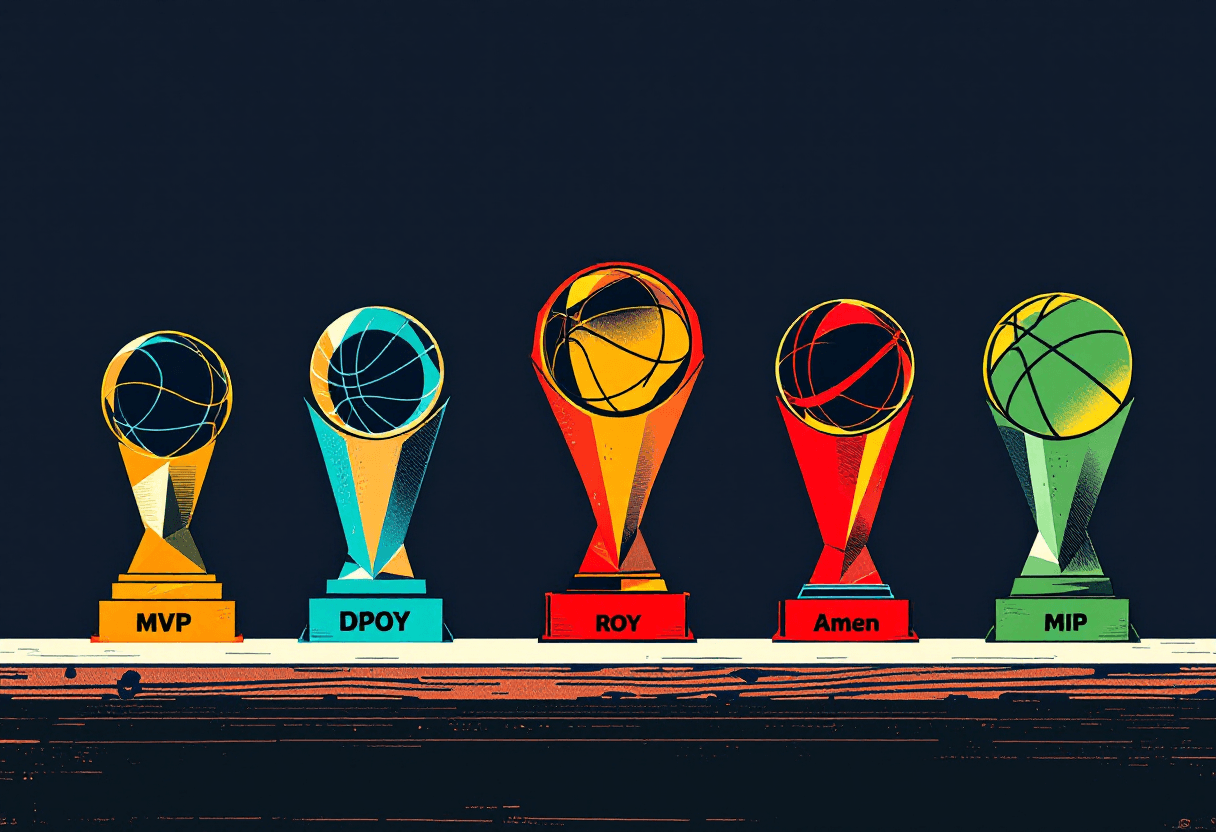
NBA awards are the game's official scorekeeping on greatness - markers of the seasons when a player was undeniably the best at something. Every one of them is also a trivia minefield. The exact year the Defensive Player of the Year was introduced, the only player to win Finals MVP on the losing team, the lone unanimous MVP in league history - these facts separate the casual fan from the obsessive one. This guide covers every major NBA individual award: when it started, who dominated it, and the voting controversies that still spark arguments decades later. The multi-time winners, the overlooked first recipients, and the records unlikely to fall.

Most Valuable Player - The Award That Started Everything
The NBA's Most Valuable Player award has been handed out since the 1955-56 season, making it the oldest individual honor in the league. Bob Pettit of the St. Louis Hawks won the inaugural trophy - a forward who went on to win it a second time in 1959, becoming one of the award's first multi-winners. The MVP has since been claimed by 34 different players, though a tight cluster of legends accounts for most of the hardware.
Kareem Abdul-Jabbar owns the record with six MVPs - 1971, 1972, 1974, 1976, 1977, and 1980 - spanning nearly a decade of dominance that no player has matched. Bill Russell and Michael Jordan each won five. Wilt Chamberlain and LeBron James each claimed four. Moses Malone, Larry Bird, Magic Johnson, and Nikola Jokić each won three. Jokić's three came in 2021, 2022, and 2024 - not consecutively, since Joel Embiid won in 2023 between his second and third. Larry Bird remains the only player to win three consecutive MVPs in the media-vote era, which began in 1980-81. Shai Gilgeous-Alexander joined the multi-winner club with back-to-back awards in 2024-25 and 2025-26.
The Unanimous MVP - Stephen Curry's 2016 Season
In 70 years of MVP voting, only one player has ever received every first-place vote: Stephen Curry in 2016. Curry swept all 131 ballots - 130 from the panel of sportswriters and broadcasters, plus the fan vote - a clean sweep that had never happened before in the award's history. The context makes it even more emphatic: Curry averaged 30.1 points per game on 50-40-90 shooting splits, made 402 three-pointers in a single season (shattering his own record), and led the Golden State Warriors to a 73-9 regular-season record that broke the all-time wins mark.
That voters couldn't find a single defector to cast a protest vote elsewhere says something specific about what Curry did to basketball that year. He was not just the best player in the league - he was rewriting what the position of point guard meant, and doing it in the middle of the most wins any team had ever produced. No player since has come close to unanimous. Curry's 2016 trophy sits in a category entirely its own.
The Youngest MVP - Derrick Rose's 2011 Coronation
When Derrick Rose won the MVP award for the 2010-11 season, he was 22 years and 6 months old - the youngest player to receive the honor in league history, breaking a record held by Wes Unseld. Rose averaged 25 points, 7.7 assists, and 4.1 rebounds per game for a Chicago Bulls team that finished 62-20, the best record in the Eastern Conference. He was explosive, fearless, and playing in his hometown - a #1 pick from Chicago who had become the reason the Bulls were a legitimate threat again after the Jordan era.
The award has always generated debate. Jordan and LeBron had statistically stronger seasons, but Rose finished ahead on the "best player on the best team" argument and pure narrative - the hometown hero lifting a franchise everyone had counted out. He is still the youngest MVP ever and still the only Bulls player other than Jordan to win the award. The ACL tear he suffered in the 2012 playoffs, before Chicago had fully capitalized on what he was becoming, became one of the sport's more melancholy injury arcs.
The Voter Fatigue Problem - Karl Malone's 1997 MVP
The 1997 MVP vote is the canonical example of the award going to the wrong player and everyone knowing it at the time. Michael Jordan averaged 29.6 points, 5.9 rebounds, and 4.3 assists per game and led the Bulls to a 69-13 record. Karl Malone averaged 27.4 points and 9.9 rebounds for a Utah Jazz team that won 64 games. Malone won by 11 points in the final tally - 63 first-place votes to Jordan's total.
Phil Jackson's explanation, widely accepted, was simple: voter fatigue. Jordan had already won five times. Voters found a reason to give it to someone else, and Malone's numbers were good enough to justify the decision if you ignored the context. Jordan's response was to use the slight as fuel - in the Finals against Malone's Jazz, he delivered a game-winning shot in Game 1, the famous Flu Game in Game 5, and a championship-clinching assist in Game 6. The 1997 Finals was Jordan's formal rebuttal, delivered in six games.

Defensive Player of the Year - The Award That Built Its Own Dynasty
The Defensive Player of the Year award was introduced for the 1982-83 season. Sidney Moncrief of the Milwaukee Bucks won the first one - a perimeter defender whose combination of lateral quickness and anticipation made him the prototype for what the award would honor. The DPOY has since been awarded 43 times, and three players share the record with four wins each: Dikembe Mutombo, Ben Wallace, and Rudy Gobert.
Mutombo won in 1995, 1997, 1998, and 2001 - a run that defined the era of dominant post defense and made his finger-wagging celebration after blocked shots into one of the most recognizable gestures in the sport. Ben Wallace's story is arguably the most remarkable in the award's history: an undrafted player from Virginia Union who won four DPOYs (2002, 2003, 2005, 2006) entirely with the Detroit Pistons, was the first undrafted player inducted into the Naismith Memorial Basketball Hall of Fame, and became the anchor of a defense that beat the Shaquille O'Neal-Kobe Bryant Lakers in the 2004 Finals without a single All-Star on the roster. Gobert won his four in 2018, 2019, 2021, and 2022 - a run interrupted only by Giannis Antetokounmpo's 2020 win.
Dwight Howard sits just behind the record with three consecutive wins - 2009, 2010, and 2011 - making him the only player in league history to win the DPOY three years in a row. The only player to ever win both MVP and DPOY in the same season is a story covered in its own right elsewhere on this site: it has happened exactly three times, with Michael Jordan in 1988, Hakeem Olajuwon in 1994, and Giannis Antetokounmpo in 2020.
Rookie of the Year - From Wilt to Wembanyama
The Rookie of the Year award predates the MVP by a season, having been first awarded after the 1952-53 campaign. Don Meineke won the inaugural trophy; Ray Felix followed in 1953-54, becoming the first African American player to receive the honor. The award has since produced some of the most staggering seasons in NBA history.
Wilt Chamberlain's 1959-60 rookie season may never be matched: 37.6 points and 27.0 rebounds per game across 72 games - numbers so extreme that the Quaker warrior also won MVP in the same year, a double achieved only once more when Wes Unseld matched it in 1969. The modern era has produced unanimous Rookie of the Year selections six times: Ralph Sampson, David Robinson, Blake Griffin, Damian Lillard, Karl-Anthony Towns, and Victor Wembanyama have all swept the first-place votes. LeBron James won in 2004, though not unanimously - a mark of how the voting panel occasionally hedges even on obvious results.
The most controversial recent winner was Ben Simmons in 2018, who won two years after being drafted because an injury cost him his first season entirely. He never played a game as a true rookie but qualified under eligibility rules that measure seasons played rather than draft year. The award has also produced three tie votes: Dave Cowens and Geoff Petrie split it in 1971, Grant Hill and Jason Kidd shared it in 1995, and Elton Brand and Steve Francis divided it in 2000.
Sixth Man of the Year - The Bench Revolution
The Sixth Man of the Year was introduced in 1982-83, the same season as the DPOY, with Bobby Jones of the Philadelphia 76ers taking the inaugural award. Kevin McHale of the Boston Celtics won the next two consecutively - 1984 and 1985 - establishing the template for what the award was measuring: not just scoring off the bench, but instant offense, energy change, and the ability to tilt a game in a quarter of play.
The record for most wins belongs jointly to Jamal Crawford and Lou Williams, each with three. Crawford won with the Atlanta Hawks in 2010 and twice with the Los Angeles Clippers in 2014 and 2016. Williams won with Toronto in 2015 and back-to-back with the Clippers in 2018 and 2019. Both players built careers almost entirely as scoring specialists off the bench, and both became reliable answers to NBA trivia questions - Crawford perhaps more for his crossover dribble, Williams for his unshakeable scoring in traffic.
James Harden won in 2012 with Oklahoma City before being traded to Houston and eventually winning an MVP as a starter - the sixth man to franchise cornerstone arc compressed into a few seasons. The five Hall of Famers who won the award are Kevin McHale, Bobby Jones, Bill Walton, Toni Kukoč, and Manu Ginóbili, the last of whom is probably the most famous sixth man in the modern game despite never becoming the leading winner.
Most Improved Player - The Arc Makers
The Most Improved Player award was first given after the 1985-86 season, with Alvin Robertson of the San Antonio Spurs taking the inaugural trophy - a season in which he also won Defensive Player of the Year and led the league in steals. No player has ever won the MIP twice; improvement is a moment, not a sustained condition.
The most famous MIP winner is Giannis Antetokounmpo, who won in 2017 after jumping from 16.9 to 22.9 points per game. He became the first MIP winner to later win MVP - which he did in 2019 and 2020 - and the first to win a championship, in 2021. The MIP-to-MVP pipeline is unique to him; the award usually marks a career inflection point rather than a launch pad. Jimmy Butler won it in 2015 after improving from 13.1 to 20.0 points per game. Pascal Siakam won it in 2019, the same year Toronto won the title.
Finals MVP - The Award That Started with a Loss
The Bill Russell Trophy - now its formal name, though it was simply "Finals MVP" for most of its existence - was first awarded after the 1969 NBA Finals. Jerry West of the Los Angeles Lakers won it despite the fact that his team lost to the Boston Celtics in seven games. West averaged 37.9 points, 7.4 assists, and 4.7 rebounds per game in the series - numbers that left voters no choice but to award him the trophy even as the Celtics celebrated. He is the only player in NBA Finals history to win MVP from the losing team, and the rule has never been formally changed - it simply has never happened again.
Magic Johnson's 1980 Finals MVP is the award at its most mythological. Johnson was a 20-year-old rookie when Kareem Abdul-Jabbar went down with an ankle injury before Game 6 against the Philadelphia 76ers. Johnson started at center, played all five positions in the same game, and finished with 42 points, 15 rebounds, and 7 assists in the clinching win - still discussed as one of the greatest individual performances in Finals history. He is the only rookie to win Finals MVP.
Michael Jordan won six Finals MVPs - one for each championship from 1991 to 1998. LeBron James has four, Tim Duncan three. The most debated recent award was Andre Iguodala's win in 2015 - he received the trophy despite not starting a single regular-season game all year, the first player to ever accomplish that. He had started all 808 previous games of his career before Steve Kerr moved him to the bench that season. Kerr started him for the Finals specifically to guard LeBron James, his defense was credited with swinging the series, and seven of eleven voters gave him the nod. The other four went to James, who was on the losing side.
The Awards That Reflect an Era
Read the DPOY winners list from 1983 to 2010 and you are reading the history of post defense in the NBA - Moncrief, Mark Eaton, Michael Cooper, Dennis Rodman, Mutombo, Wallace, Howard, one center or power forward after another. Then read it from 2011 to the present and you see the game's shift toward switchability and perimeter coverage. Gobert's four wins are about rim protection in a spread offense world. Kawhi Leonard's two wins (2015, 2016) were built on perimeter lockdown. The DPOY list is an accurate mirror of how the league's defensive priorities changed decade by decade.
The MVP list tells the same story. From the 1980s to 2000, high-usage scorers and dominant bigs collected nearly every trophy. Steve Nash's back-to-back wins in 2005 and 2006 - without averaging 20 points a night - signaled the arrival of pace-and-space thinking. Curry's unanimous 2016 trophy extended that trend. Jokić's three MVPs, built on playmaking from the high post and historically efficient interior scoring, represent something the award had never quite been built to reward.
Related Reading
- The Most Controversial MVP Races in NBA History
- Every NBA Player to Win MVP and DPOY in the Same Season
- The Best Sixth Men in NBA History
- The NBA's Greatest Defensive Players of All Time
- The Most All-Star Selections in NBA History
Award history is the connective tissue of NBA trivia - once you know who won what and when, entire eras of the league click into place. Test how much of this has stuck with our daily Who Am I? quiz, where award winners hide behind their career clues, and our Two Truths 1 Lie game, where fake award attributions are one of the most reliable traps we set.