
The biggest hands in NBA history belong to a tiny club of giants - most of them legitimate seven-footers, a couple of them merely 6'7" guards with anatomy that doesn't match their frames. Boban Marjanović is the unofficial all-time record holder. Kawhi Leonard owned the largest hand-span ever measured at the NBA Draft Combine when he entered the league in 2011. Tacko Fall holds the combine record for hand length. The full list mixes verified combine numbers with a handful of historical reports that predate official measurement. The ones we can trust are the ones below.
How NBA Hand Size Is Measured
The NBA Draft Combine has officially measured prospect hand size since 2010. Two numbers get recorded: hand length (base of the palm to the tip of the middle finger) and hand span / width (thumb tip to pinky tip with the hand outstretched). Length tells you how far the hand extends down a basketball. Span tells you the player's actual reach across one. The average NBA prospect comes in around 9.5 inches in length - already a full two inches longer than the average adult male hand of roughly 7.6 inches. Anyone over 10 inches in length or 11.5 inches in span is, by combine standards, a true outlier.
For context, the regulation NBA basketball is 29.5 inches in circumference, which works out to a diameter of about 9.4 inches. That single number explains every photograph in this article. A hand of 10 inches or more can wrap around the ball with finger room to spare. An 11.5-inch span can stretch across the entire surface and pin the ball one-handed with three fingertips. The math is the trick - no magic, only inches. Players measured before 2010 only have estimated figures based on reporter coverage and photographic comparison, and the pre-combine names below are flagged accordingly.
The Biggest Documented Hands
Boban Marjanović - ~10.75" length, ~12" span (estimated)
The 7'4" Serbian center holds the unofficial all-time record for the largest hands in NBA history. The figures are estimates rather than combine numbers - Marjanović entered the NBA via free agency with the Spurs in 2015 rather than the draft - but the photos do most of the verifying. Side-by-side images of Boban palming a basketball with one hand make a regulation ball look like a softball. His NBA career was a cult role-player run across the Spurs, Pistons, Clippers, Sixers, Mavericks, and Rockets from 2015 to 2024, capped by a 27-point, 12-rebound night for Detroit in April 2017. A decade of sub-15-minute bench appearances, and the hands still spawned a permanent meme that outlives every stat line.
Kawhi Leonard - 9.75" length, 11.25" span (2011 combine)
Leonard's hand span of 11.25 inches was the largest ever measured at the NBA Draft Combine when he entered the league in 2011. The length was 9.75 inches. At 6'7" with a 7'3" wingspan and an 8'10" standing reach, Leonard's hands are disproportionately massive for his frame - closer to the proportions of a 7'4" center than a wing. Those measurements quickly became the explanation for his entire game. He could palm the ball one-handed off the dribble. He could deflect entry passes at angles that didn't look reachable on the film. The nickname "The Klaw" got attached to him almost immediately, and Leonard eventually traced his own hand to design a personal logo for endorsement deals. The combine-era credibility makes this the most reliably documented elite hand-size measurement on the list.
Shaquille O'Neal - ~10.25" length, ~12" span (estimated)
Shaq's hands are well-documented in photos and reporter accounts but predate the official combine - he entered the league in 1992, eighteen years before measurement started. The most-cited figures place his length around 10.25 inches and his span at 12 inches, behind only Boban and well ahead of any other player in modern memory. The 7'1", 325-pound frame did most of the work in the paint, but the hand size is the reason the ball never looked dislodged on a power dribble through a triple-team. Anyone who watched a Shaq tomahawk knows the numbers feel right.
Tacko Fall - 10.50" length (2019 combine)
The Senegalese 7'6" center owns the combine-era record for hand length at 10.50 inches, set at the 2019 NBA Draft Combine. He went undrafted that year, signed a two-way contract with the Boston Celtics, and played 26 NBA games over two seasons before moving overseas. The on-court career was brief, but the measurement is permanent. Fall also shattered combine records for height (7'5" without shoes), wingspan (8'2.25"), and standing reach (10'2.5") at the same combine - a once-in-a-decade anthropometric outlier whose proportions sit a half-foot beyond ordinary NBA-center territory. His hand length still leads the combine field a full six years later.
Hugo González - 10.25" length (2025 combine)
The 6'6" Spanish guard, drafted 28th overall by the Boston Celtics in 2025, posted a hand length of 10.25 inches at the 2025 NBA Draft Combine - the second-longest measurement in combine history behind only Tacko Fall, tied with Xavier Tillman and Dexter Pittman. The fact that all of that hand belongs to a 6'6" guard is the part that makes it absurd. His proportions echo Kawhi's - wing height, center hands - which is why the Celtics moved up for him. He's still a developmental project, but the physical tools are the same kind of advantage that took Leonard from #15 overall to two-time Finals MVP.
Michael Jordan - 9.75" length, 11.375" span (reported)
Jordan's hands have been reported at 9.75 inches in length and 11.375 inches in span - figures that predate the combine and rely on outside measurement. At 6'6", those numbers would be in line with someone closer to 7'9". The legend builds from there: photographs of Jordan extending the ball away from defenders during 1991 Finals layups still circulate as the canonical proof. The hand size is part of the explanation for the way Jordan finished through traffic, switched hands midair, and pulled the ball back from above the rim during dunks.
Julius Erving - ~9.5" length, ~11.75" span (estimated)
Dr. J's reputation for huge hands is older than the combine itself. Estimates of his hand length sit around 9.5 inches with a span of roughly 11.75 inches - the figures vary across sources, but the on-court footage is the verification. Erving could palm a basketball off the dribble in junior high. The signature finger-roll, the cradle move, the windmill dunks of the ABA years - every one of them relied on a grip that turned the ball into a one-handed prop.
The Pre-Combine Era - Folklore vs Measurement
Wilt Chamberlain - ~9.5" length, ~11.5" span (estimated)
Wilt's reputation for having gigantic hands is everywhere - interviews, reporter accounts, photos of him cradling a basketball with finger room to spare - but no official measurement exists. The estimates that circulate place him around 9.5 inches in length and 11.5 inches in span, modest figures relative to Boban or Shaq but matched to a 7'1" frame and the most physically dominant interior career in pre-merger NBA history. The hands made the 100-point game easier. They also made the 55-rebound game more plausible than the math should allow.
Connie Hawkins - ~10.5" length (estimated)
The Brooklyn schoolyard legend turned ABA MVP turned Phoenix Suns franchise player whose teenage palm-the-rock highlights became the stuff of NBA mythology. Hawkins's hand length has been estimated at roughly 10.5 inches in older reporting - second only to Boban on any all-time list, if the estimate is right. The descriptions read like a different sport. He could whip a Globetrotter-style behind-the-back pass with one hand from 50 feet. He cradled the ball like a grapefruit on the way to creative finger-roll finishes that influenced Erving and Jordan after him. Hawkins is the closest thing the pre-combine era has to a Boban analog - a player whose hand size became the reason the rest of his game looked supernatural.
Manute Bol - large hands, no specific measurement
The 7'7" Sudanese center who blocked 397 shots as a Washington Bullets rookie in 1985-86 had the longest wingspan ever recorded in the NBA - 8'6". Specific hand-length numbers don't appear in reliable contemporaneous reporting. What's documented is the proportional case: a 49-inch inseam, a wingspan that exceeds a foot beyond his already-absurd height, and on-court footage of him pinning shots one-handed at the rim. The hands almost certainly belonged at the top of any list. The lack of formal measurement means he gets an honorary entry rather than a verified one.
These are the cases where folklore and reasonable estimation meet. The measurements aren't lab-grade, but the players belong on any honest list.
Why Hand Size Doesn't Always Translate
Massive hands help, but they don't make a star. Boban Marjanović has the biggest hands ever recorded - and a career role as a bench center who plays 12 minutes a night. Tacko Fall set the combine length record and played 26 NBA games. Greg Smith posted a 12-inch span at the 2011 combine - the widest ever measured - and lasted 132 NBA games across five seasons before moving overseas. Noah Vonleh's 11.75-inch span at the 2014 combine made him one of the most physically gifted prospects in his class; his actual NBA arc has been a journeyman power forward across nine franchises, averaging single-digit scoring.
Kawhi Leonard's case is the counterargument. His hand size is an obvious advantage, but his two-time Defensive Player of the Year run, two Finals MVPs, and All-NBA selections are built on his work ethic, defensive intelligence, and shooting touch as much as his palms. Hand size is a useful trait, not a destiny. The combine measures it because it correlates with finishing through contact and steals - not because it predicts careers.
The Counter-Examples - Stars with Smaller Hands
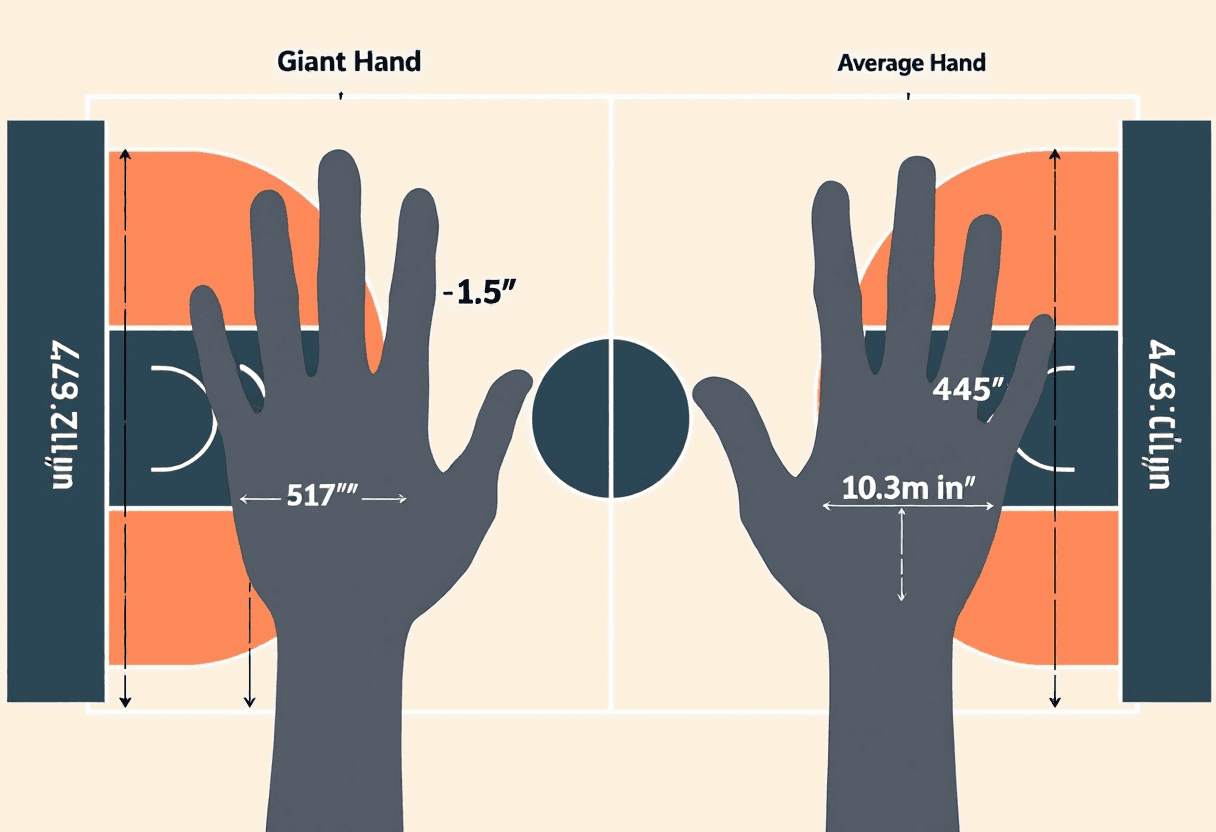
Plenty of star NBA guards have unremarkable hand measurements and use technique to compensate. Stephen Curry is the standout. His hand length is reported at roughly 7.6 inches - close to the average adult male hand and well below the NBA prospect average of 9.5 inches. He has built one of the most influential careers in NBA history on a hand-size profile closer to a tall recreational player than a top-15 combine prospect. Two MVPs and four titles later, his shooting form is the verification: a higher release point and a wrist-snap motion that compensates for less ball-grip surface area. The skill-acquisition curve in the NBA bends harder than physical tools do - the players who learn to shoot, pass, and finish with average hands tend to become more interesting than the project bigs whose hand size is the headline of their draft profile.
The Hand-Size Advantage - Where It Actually Helps
Where it does help is in three specific places.
Ball control off the dribble. A larger hand grips the ball with less surface exposure to a reaching defender. The player can keep the ball higher in the dribble cycle and pull it back more abruptly without losing control - the trait behind Erving's open-floor moves and Jordan's mid-drive hesitation dribbles.
Finishing through contact. A palmed ball doesn't dislodge on a forearm. Players with elite grip can pump-fake, gather, and finish through bodies that would knock a normal hand loose. Shaq's tomahawks, Erving's cradle-finishes, and Kawhi's spin-into-the-paint scoop layups all rely on the same trait at the gather point.
Steal opportunities and deflections. A hand that can intercept and immediately control the ball - rather than swat it loose - turns deflections into possessions. Kawhi's 11.25-inch span at the 2011 combine isn't just a measurement; it's the explanation for why he became one of the era's most efficient ball-hawks despite below-average lateral foot speed.
The list explains why specific moves looked the way they did. It does not predict careers. Many of the names are role players. The ones who became stars used the hands as one tool among many.
How the Combine Measures Hands Today
The protocol hasn't changed since 2010. Players stand with their fingers spread on a flat panel marked at every quarter-inch. Hand length is measured from the base of the palm - where the wrist creases meet the hand - to the tip of the middle finger. Hand span is measured from thumb tip to pinky tip with the fingers fully extended. Both numbers are recorded to the nearest quarter-inch.
Teams use the hand numbers as one variable in scouting models, weighed against game film and the rest of the physical profile. A 10-inch hand on a 6'2" guard is more interesting than a 10-inch hand on a 7'5" center, because the proportional advantage is larger. That's why Kawhi's 9.75-inch hands at 6'7" generated more attention than Tacko Fall's record-setting 10.5-inch hands at 7'6". Length matters; the ratio matters more.
Over the past 15 years, only four players have measured over 10 inches in hand length at the combine: Tacko Fall at 10.50 inches in 2019, and Hugo González, Xavier Tillman, and Dexter Pittman all tied at 10.25 inches. Everyone else is large for the NBA but not large in absolute terms. The 10-inch threshold has held up as the ceiling separator since the combine started keeping records.
What the List Tells You About the NBA
Read the names end-to-end and a few patterns emerge. Many of the most cinematic dunkers and finishers in NBA history sit on the hand-size list. Erving, Jordan, Hawkins, Shaq, Kawhi. The grip is part of why the highlight reels work - every one of those players turns the ball into a prop that obeys one hand. The pre-combine names skew toward folklore. Wilt, Bol, Hawkins, even Shaq pre-2010 - we have estimates and photographs, not measurements. The mythology gets bigger because the verification is smaller. The combine-era names show how rarely the proportions translate to stardom. Tacko Fall, Greg Smith, Noah Vonleh, Boban Marjanović - each one anchors a physical record, and none of them ever made an All-Star team. The hand size is a feature, not a forecast.
The combine started recording hands in 2010 specifically because teams wanted a quantifiable variable for traits - ball control, deflection ability, finishing through contact - that scouts had been describing anecdotally for decades. The numbers settle the folklore. They do not settle the careers.
Related Reading
- 15 NBA Records You Probably Didn't Know Existed
- The Biggest Busts in NBA History
- Fascinating NBA Number Facts: Stats That Will Surprise You
- The Tallest NBA Players in History
Match faces, careers, and quirks like these in our daily NBA Bingo - every tile pulls from a different corner of basketball history. And if you want to test how well you can pick out an NBA legend from a handful of clues, our Who Am I? quiz hides combine-era prospects, pre-combine giants, and modern stars behind hint trails that span every era of the league.