
Every basketball builder, video game or otherwise, presents the same lie: a grid of sliders that all look equally important. Put a point in vertical leap or a point in mid-range shooting and the interface treats them as equivalent purchases. They are not remotely equivalent. Decades of tracking data have produced a fairly clear answer about which basketball skills actually move winning and which ones mostly generate highlights, and the gap between the two lists is much wider than most builds assume. Here is what the evidence says about building a player who is genuinely valuable, from shot selection to the attributes worth spending on to the age at which any of it stops improving.
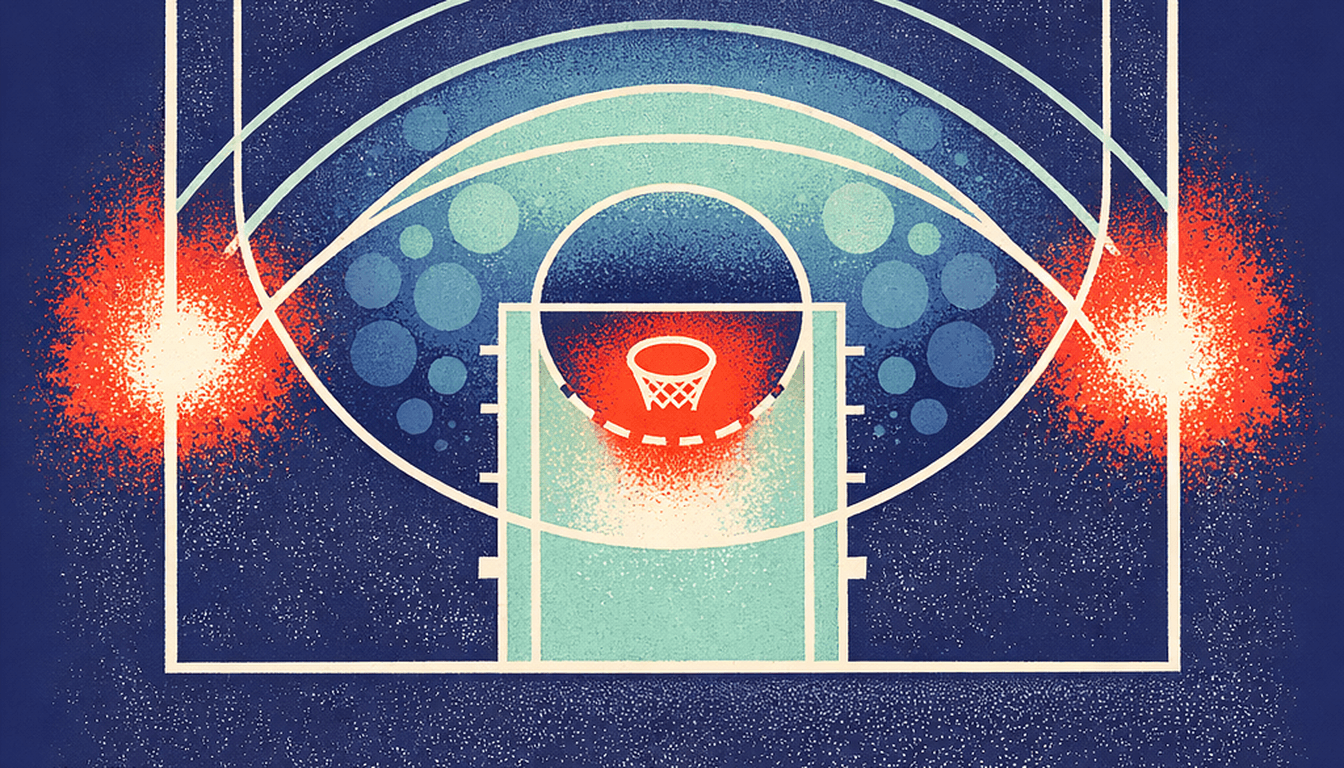
Start With the Shot Chart, Not the Position
Before a single attribute, decide where your player shoots from. Nothing else you choose will matter as much.
Across the last two decades of NBA shooting, the returns by zone are stark:
- Corner three: 1.16 points per attempt
- Above-the-break three: 1.05 points per attempt
- Two-point jumper outside the restricted area: 0.79 points per attempt
That is not a small edge. It is a 47% difference between the best jump shot and the worst one, and it holds across eras, teams, and shooter quality.
The counterintuitive part is that the mid-range jumper is the most accurate jump shot on the floor. Players hit it at around 40.9%. The three-pointer from above the break goes in about 38.6% of the time. The mid-range shot is more likely to go in and still pays worse, because 2 x 0.409 = 0.82 while 3 x 0.386 = 1.16. Accuracy and value are different questions, and shot selection resolves the difference before the shot is taken.
The practical translation: a player who takes corner threes and shots at the rim is more valuable than a better shooter who takes long twos. If a team swapped ten mid-range attempts per game for ten corner threes, the projected gain is roughly 3.7 points per game, which over a season is worth close to ten wins.
Efficiency Beats Volume, and It Is Not Close
Points per game is the stat every casual conversation runs on and one of the weaker predictors of winning available. It correlates with wins at about 0.77, which sounds strong until you compare it to efficiency measures, which do better.
True shooting percentage accounts for twos, threes, and free throws in a single number, and it is a stronger indicator of winning than raw scoring. The reason is intuitive once stated: a player scoring 25 points on 22 shots is helping. A player scoring 25 points on 30 shots is spending possessions his team could have used better. The scoring line looks identical on a highlight package and opposite on a scoreboard.
If a builder makes you choose between "scores more" and "scores more efficiently," take efficiency every time.
What Actually Correlates With Winning
Run the standard box score against team wins and the results reorder the priorities most people bring to a build:
- Assists: moderately strong positive correlation. Each one converts directly into points.
- Defensive rebounds: moderate positive, around 0.45. Ending the opponent's possession has real value.
- Offensive rebounds: slightly negative, around -0.21. This surprises people, but crashing the offensive glass means not getting back on defense, and the trade is usually bad.
- Steals and blocks: weak positive. Both are valuable and both are noisy, because the gambles that generate them also generate breakdowns.
- Turnovers and fouls: weak negative. Avoiding mistakes matters, but less than the highlight-averse assume.
The headline is that the two most celebrated defensive statistics, steals and blocks, are among the weakest signals in the entire box score, while the least celebrated, the defensive rebound, is among the strongest. A build that spends everything on shot-blocking is buying the appearance of defense.

Free Throw Percentage Is a Leading Indicator
Here is the single most useful piece of scouting knowledge for building a player: free throw shooting predicts future three-point shooting.
Research on shooting development has found that college free throw percentage is predictive of whether a player's three-point shot improves in the NBA. The logic is that free throws isolate shooting mechanics from everything else. No defender, no movement, no fatigue variance, same distance every time. A player who shoots 85% from the line has repeatable mechanics that can be extended to the arc. A player at 62% has a mechanical problem that distance will amplify.
If you are deciding whether a player's shooting will develop, free throw percentage tells you more than his current three-point percentage does, because three-point percentage on low volume is mostly noise.
Size Is a Floor, Not a Skill
Height and wingspan are real advantages, and they are also the attribute most consistently overvalued in both real scouting and player builders.
The history of the draft is substantially a history of teams paying premium prices for physical tools that never converted. The pattern is consistent enough to be a rule: length gets you into the league and skill keeps you there. A 7-footer who cannot shoot, pass, or move his feet is a backup. A 6'3" guard who can do all three is a starter.
Size is best understood as a multiplier on skill rather than a substitute for it. Give a skilled player length and you get a problem no defense can solve. Give an unskilled player length and you get a player who is tall.
Build for the Role You Will Actually Play
The most common build mistake is designing a first option when almost nobody gets to be one.
There are 30 teams and perhaps 25 players in the league who genuinely create their own offense at a high level. Everyone else plays off them, and the skills that make an off-ball player valuable are different: catch-and-shoot accuracy, cutting, screening, defensive positioning, and not needing the ball to be useful.
This is also the more durable career. Players who transition toward catch-and-shoot threes extend their productive years by an estimated two to four seasons on average, because that skill degrades much more slowly than the burst required to create a shot off the dribble. A build centered on self-creation peaks higher and falls off a cliff. A build centered on shooting and defense holds its value for a decade.
The Usage Trap
There is a tradeoff buried in every build that sliders never show you: efficiency and usage pull against each other.
A player who takes six shots a game gets to take only his best six looks. Give the same player twenty-five shots and the extra nineteen come from harder places, against better defenders, later in the clock. His percentages fall, not because he got worse, but because the shots did. This is why comparing efficiency across wildly different roles is misleading, and why a bench scorer's gaudy true shooting rarely survives promotion to a starting role.
The build implication is that "efficient" and "high volume" are two purchases, not one. A player who can carry heavy usage while staying efficient is genuinely rare and worth building toward. A player who is efficient only at low volume is a valuable role player who will be exposed the moment a team needs him to do more. Decide which one you are making, because the attributes that get you there differ.
Position Is Nearly Dead, Matchups Are Not
Modern rosters are not built from five positions. They are built from a set of capabilities that need to be covered: someone has to create advantage, someone has to space the floor, someone has to protect the rim, someone has to guard the opponent's best perimeter player, and everyone has to be able to switch without becoming a target.
The word that matters is target. Defenses do not attack positions, they attack the weakest defender on the floor, and they will run every possession at him until he is removed. A player who cannot hold up defensively is not merely neutral on that end. He is a liability that the opposing offense will deliberately seek out, which is why so many gifted offensive players find themselves on the bench in the fourth quarter of close games.
This is the strongest argument for building defensive competence even when the builder makes offense more attractive. You do not need elite defense. You need to not be the hole. The difference between a poor defender and an adequate one is the difference between playing in the games that matter and watching them.
The Age Curve Is Real and It Is Short
Career trajectory research divides an NBA career into three phases: development from roughly 19 to 24, prime from 25 to 29, and decline from 30 onward.
That is a five-year prime. Not fifteen. Everything before it is an investment period and everything after is managed depreciation, which is why front offices are so reluctant to pay for a player's early thirties and so aggressive about acquiring his early twenties.
Skills within that curve age unevenly. Explosiveness goes first, which is why rim pressure and self-creation fade earliest. Shooting, feel, and positional defense age far better, which is why the players with long careers are so often the ones who were never dependent on athleticism. Elite shooters frequently show a delayed peak, arriving later and lasting longer than the general curve suggests.
A Build That Actually Works
Put every piece together and the evidence-backed build looks like this:
- Shoot from the corners and the rim. Skip the long two entirely.
- Prioritize efficiency over volume. True shooting is the number that matters.
- Buy passing. Assists correlate strongly and playmaking ages well.
- Buy defensive rebounding. It is the most underrated line in the box score.
- Treat steals and blocks as luxuries. Positioning beats gambling.
- Check the free throw stroke. It is the best predictor of shooting growth.
- Use size as a multiplier, never as the plan.
- Build for off-ball value. It is more useful and it lasts longer.
None of this is exotic. It is roughly what every analytics department in the league concluded a decade ago, and the reason it still feels contrarian is that the box score was designed to record events rather than to measure value. Points, blocks, and offensive rebounds are the most visible things a player does. Efficiency, spacing, and the defensive rebound that quietly ends a possession are the things that win.
One caveat worth holding onto: none of this describes what a player is, only what a team can measure. Feel, decision speed, screen navigation, and the willingness to make the extra pass barely register in a box score and separate good players from great ones constantly. The numbers narrow the search and rule out the obvious mistakes; they do not finish the job.
Build the second player. He is less fun to watch for ten seconds and considerably better to have for ten years.

Related Reading
- The Three-Point Revolution: How the NBA Changed Forever
- How NBA Players Actually Develop
- The Best Assist-to-Turnover Ratios in NBA History
- 20 Most Underrated NBA Players of All Time
You can put all of this into practice in Career Mode: build a player, pick his strengths, and watch an 82-game season decide whether you were right. Sharpen your stat instincts with our daily Higher or Lower quiz.