
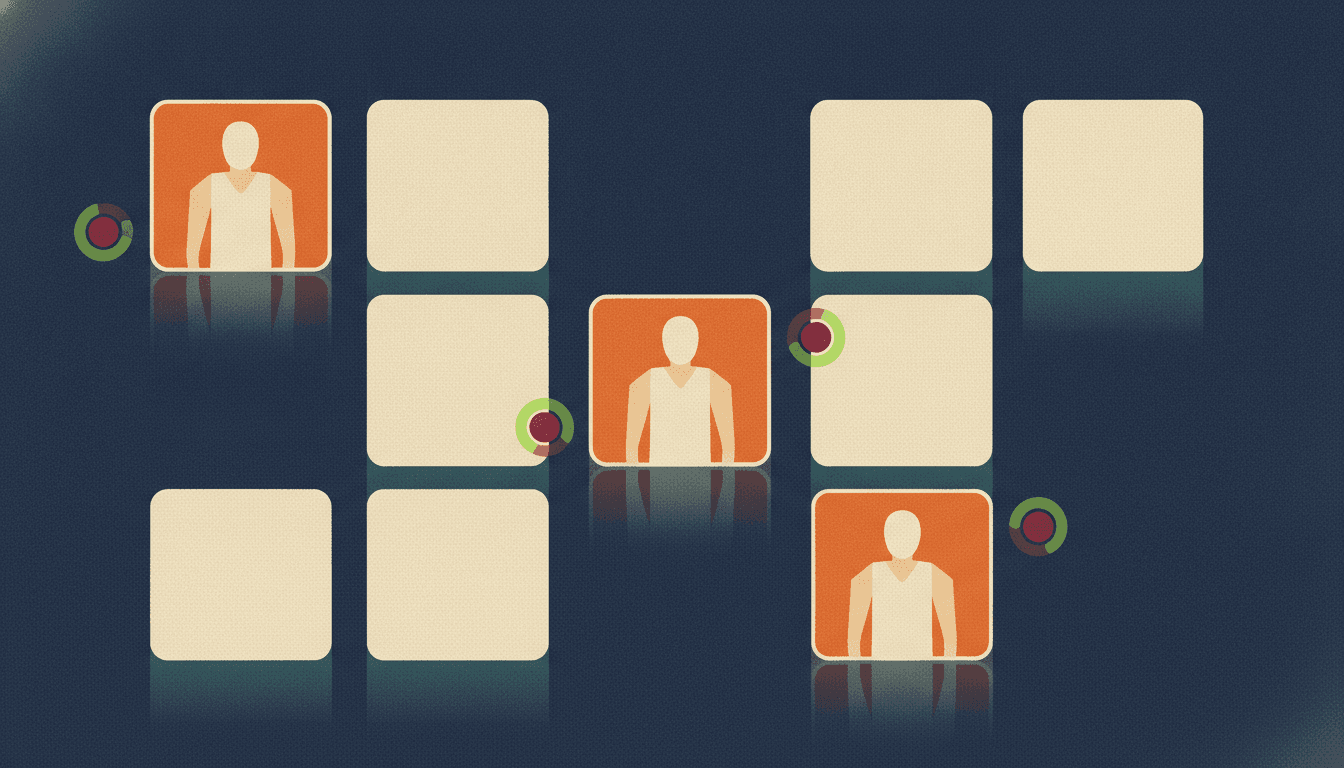
HoopGrids is the NBA grid game most people mean when they type "hoop grids" into a search bar: a three-by-three board where every row and column is a team, a stat line or an award, and every one of the nine squares wants a player who fits both. It arrived in the summer of 2023 as a basketball spin-off of baseball's Immaculate Grid, it posts a new board every evening at 8PM Eastern, and it scores you not on whether you were right but on how rare your right answers were. This guide covers how HoopGrids works, what its rarity tiers actually mean, the modes it has grown since launch, where the format strains, and how airball.gg's own Hoop Grid, a nine-guess version with crowd rarity, differs from it square by square.
What Is HoopGrids?
HoopGrids lives at hoopgrids.com and describes itself in one line: a daily NBA grid game, fill the grid with your knowledge of past and present players, new grid every day at 8PM ET. The board is three rows by three columns. A typical day puts three teams down the side, say the Spurs, the Rockets and the Mavericks, and three qualifiers across the top, something like 900 or more points in a season, five or more assists per game in a season, and a 40 percent three-point season. Each square is the intersection of one row and one column, and your job is to name a player who satisfies both.
What made the game spread in 2023 was the second layer. Beside every correct answer HoopGrids shows a percentage: the share of everyone who played that day's board and named the same player in that square. The lower the number, the rarer the answer, and your rarity score for the whole grid is built from those nine percentages. Bullets Forever's August 2023 walkthrough put it plainly: LeBron James works for a Cavaliers and Lakers square, but a player you had to look up would score better.
Where the Grid Came From: Immaculate Grid, April 2023
HoopGrids is a descendant, and it says so. The original is Immaculate Grid, a baseball game built by Brian Minter, a software developer from Atlanta, who posted the first grid on April 4, 2023 and named it after the immaculate inning, the one where a pitcher strikes out three batters on nine pitches. Immaculate Grid gives you nine guesses for nine squares, one per square, so a perfect board means nine correct picks in a row. Miss once and the grid can never be immaculate. The rarity score was added later, once the game had an audience, to push people past the obvious names.
For its first two months the game was mostly Minter and his friends. A Reddit post found it a crowd, a share from the account @FoolishBB on June 13 made it a phenomenon, and by July it was averaging around 200,000 players every weekday. Sports Reference bought it on July 11, 2023, wired each square to the lists of valid answers on Baseball Reference, and launched its own basketball version on July 25. HoopGrids had already staked out the NBA by then, with one deliberate difference from the original.
How a HoopGrids Board Works
The rule that trips up newcomers is that the two categories in a square are independent. HoopGrids' own how-to-play page uses the example of Played for the Chicago Bulls crossed with 1,000 or more points in a season: the player needs a 1,000-point season at any point in his career, not necessarily while he was a Bull, plus at least one regular-season or playoff game for Chicago. Nothing has to happen in the same season, or even the same decade.
That single rule reshapes every square:
- A team-and-team square wants a player who logged at least one regular-season or playoff game with each club, in any order, any era.
- A teammate-and-team square wants a player who shared at least one game with the named teammate and played at least one game for the team, and the two facts do not have to overlap.
- A stat-and-team square wants a player who hit the stat at some point and wore the jersey at some point, separately.
- A teammate-and-stat square, such as a 40-point game crossed with a named teammate, wants one game alongside that player and one 40-point night, anywhere in the career.
Because "played for" means one game, the richest answers are the ten-day contracts, the deadline throw-ins and the final-season cameos. A Hall of Famer who played 20 games for a team on his way out counts exactly as much as the franchise icon who played 1,000, and he scores far better.
Unlimited Guesses, Hint Mode and Reverse Mode
The deliberate difference from Immaculate Grid is the guess budget. There is none. HoopGrids gives you unlimited guesses for every square, and you can change a submitted player by clicking the square again, even after the board is complete. You are not docked for guessing, so you can experiment until you land on something you like.
Two modes sit on top of that. Hint mode shows you six players for a square, one of whom is the most common guess other players made, which turns a blank into a multiple choice. Reverse mode flips the objective: instead of chasing the rarest correct answer you chase the most common one, and your pick is ranked from first to sixth most common. The most common player earns a fire icon in place of the unicorn, second through sixth take the usual tiers in reverse, and anything outside the top six gets a cold-face icon. You can switch reverse mode on or off at any point during a game.

The Rarity Score, Tier by Tier
HoopGrids sorts every correct answer into a tier by the percentage of worldwide guesses it accounts for in that square. The bands, from the how-to-play page:
- Common: more than 15 percent of guesses.
- Bronze: 10 to 15 percent.
- Silver: 5 to 10 percent.
- Gold: 1 to 5 percent.
- Blue: 0.1 to 1 percent.
- Galaxy: 0.06 to 0.1 percent.
- Unicorn: 0.05 percent or less.
The rarity is computed in real time against everyone playing, so an answer can slide from gold to silver during the evening as other people find it. That is the trade the format makes. Rarity is not a measure of how obscure a player is in the abstract; it is a measure of how many of today's players thought of him.
The Extras That Grew Around the Daily Board
The daily board is the habit, but the site has grown a shelf of extras. An archive lets you play old grids. Create a Board lets you build your own and send it to friends. A speedrun mode times you, and a stats page, a leaderboard and a friends list keep score. The newest addition is a 1v1 Challenge Mode: two players share one board live, take turns picking a square, both name a player in secret, and the rarest correct answer wins the square. The same group runs an NFL version at gridirongrids.com and an MLB version, and a premium sign-up removes the ads.
Where HoopGrids Falls Short
Nothing here is a complaint about a free game that has entertained millions. These are the places the format strains, and they are worth knowing before you choose where to spend your daily grid.
The unlimited guesses remove the stakes. Immaculate Grid's nine-guess rule is what makes a finished board feel earned: every name you type costs something, so you think before you type. On HoopGrids a wrong guess costs nothing, and a square can become a scroll through everyone you half-remember until one sticks. The rarity score is supposed to be the discipline that replaces the guess budget, but it only disciplines people who care about it.
Rarity measures the crowd, not you. Because the percentages come from today's players, the same answer can be a unicorn on a quiet day and silver on a busy one. Your score drifts with the room.
Hint mode shows you a name. Six players, one of them the crowd's favorite, is a generous nudge for a trivia game whose whole appeal is recall. And the clock is Eastern: a new grid at 8PM ET is a morning puzzle for Europe and an afternoon one for Asia, so the board you open is one the American evening has already solved, and the percentages already say so.
Hoop Grid: airball.gg's Daily NBA Grid Game
Hoop Grid is airball.gg's version of the format, one of the seventeen daily games on the site, and it keeps the original's discipline. The in-game instruction is the whole rule: name a player who fits both categories, 9 guesses, 9 cells. A wrong guess is gone. A cell you cannot fill stays empty. The board resets on your local day, not on an East Coast evening, and nobody needs an account to play it.
Rarity is there too, and it works the way the grid games taught everyone to expect, as a share of the crowd. Each filled cell scores the percentage of that day's players who made the same pick in that cell, an empty cell scores a flat 100, and lower is better. A pick nobody else made at all is a unicorn, and a signed-in player who fills every cell with unicorns takes the rainbow grid. The percentages only start to mean anything once ten grids are in for the day, so early birds see their cells settle as the crowd arrives, and the rarity board ranks signed-in players by score. Rarity is a prestige table, not the economy: the points you bank on airball.gg come from playing the day's games, and no amount of unicorn hunting changes them.
The categories lean the same way as the original. The rows are NBA teams, the columns a fourth team, an award or a stat line, and legacy franchises count under their modern codes, so a Sonics answer works for the Thunder cell and a Vancouver Grizzly for Memphis.
HoopGrids vs Hoop Grid, Square by Square
Here is how the two boards differ on the decisions that matter:
- Guesses: HoopGrids gives unlimited guesses and lets you revise a square after finishing. Hoop Grid gives nine for nine cells, and a wrong one is spent.
- Rarity: HoopGrids sorts answers into seven named tiers from common to unicorn, computed worldwide in real time. Hoop Grid scores each cell as a plain percentage of the day's crowd, with 100 for an empty cell and a unicorn for a pick nobody else made.
- Hints: HoopGrids has a hint mode that shows six names. Hoop Grid has none; the tips live on the game page, not in the cell.
- Reset: HoopGrids posts at 8PM Eastern. Hoop Grid turns over on your own local day.
- Modes: HoopGrids has reverse mode, a speedrun, an archive, a board builder and a 1v1 challenge. Hoop Grid is one board a day, and the rest of the site is sixteen other games.
- Cost: HoopGrids is free with a premium tier that removes ads. Hoop Grid is free and needs no sign-up, with an account only for the rarity board.
If you want a sandbox to explore a square until you find the rarest name, HoopGrids is built for that. If you want nine guesses that each cost something, and a score that comes from recall rather than revision, that is the version Immaculate Grid started with, and the one Hoop Grid keeps.
Strategy That Works on Both Boards
The same instincts win on either site, because the squares are built from the same facts.
- Scan all nine cells before you type. A well-traveled veteran can fit three cells; decide where you need him most.
- Read "played for" literally. One regular-season or playoff game is the bar. The best team-and-team answers are trade throw-ins and final-season cameos, not the faces of either franchise.
- Never pick the first player that comes to mind unless you are sure he is obscure enough. That was the Bullets Forever rule in 2023, and the rarity math has not changed.
- On HoopGrids, a Hail Mary is free, so throw them. On Hoop Grid it costs one of nine, so only throw one when the cell is otherwise empty.
- Learn the legacy codes. Sonics to Thunder, New Jersey to Brooklyn, Vancouver to Memphis, San Diego to Houston. Both games count them, and both crowds forget them.

Games Like HoopGrids
The grid family is wide now. Immaculate Grid's own basketball board, launched by Sports Reference on July 25, 2023, keeps the nine-guess rule and links every square to Basketball Reference. On airball.gg the nearest neighbours to the grid are the category games: Connections asks you to sort sixteen players into four hidden groups, Who Am I hands you a career in clues, and Career Path shows you the franchises and asks for the man who played for all of them in that order. They scratch the same itch as a team-and-team square, the memory of who went where, without the three-by-three.
Every grid game is a bet that NBA fans remember transactions better than they think they do. The hard part is holding the map of who passed through each team, the 20-game stops and the deadline throw-ins, and a nine-square board is the smallest shape that makes that map worth carrying. HoopGrids made the map a scoreboard by letting the crowd grade your answers. Immaculate Grid made it a test by limiting your guesses. Hoop Grid keeps the test and adds the scoreboard. Which one you open each morning depends on whether you want to explore or to be examined, and the honest answer for most fans is both, on different days.
Related Reading
- NBA Grid Game: How to Play the Daily Basketball Grid
- Best NBA Trivia Games to Play Online in 2026
- The Most Traded Players in NBA History
- The Best Undrafted Players in NBA History
Nine cells, nine guesses, and a crowd to beat: play today's Hoop Grid, then sort sixteen names into four groups in Connections.