
If you have searched "era ball" lately, you were almost certainly looking for one thing: Era Ball, the browser game at eraball.com where you spin a wheel of NBA franchise eras, draft nine players and a coach from whatever decades the wheel hands you, and simulate a full season to learn whether a 1960s center and a 2020s point guard can share a floor. It is also the game with the roguelike Era Gauntlet mode. This guide explains how Era Ball plays, what the Gauntlet is, how often each mode resets, and how to draft well across decades. Then it covers the games like it - starting with airball.gg's own Era Draft, the closest match, and three more daily games that reward the same era knowledge.
What Is Era Ball?
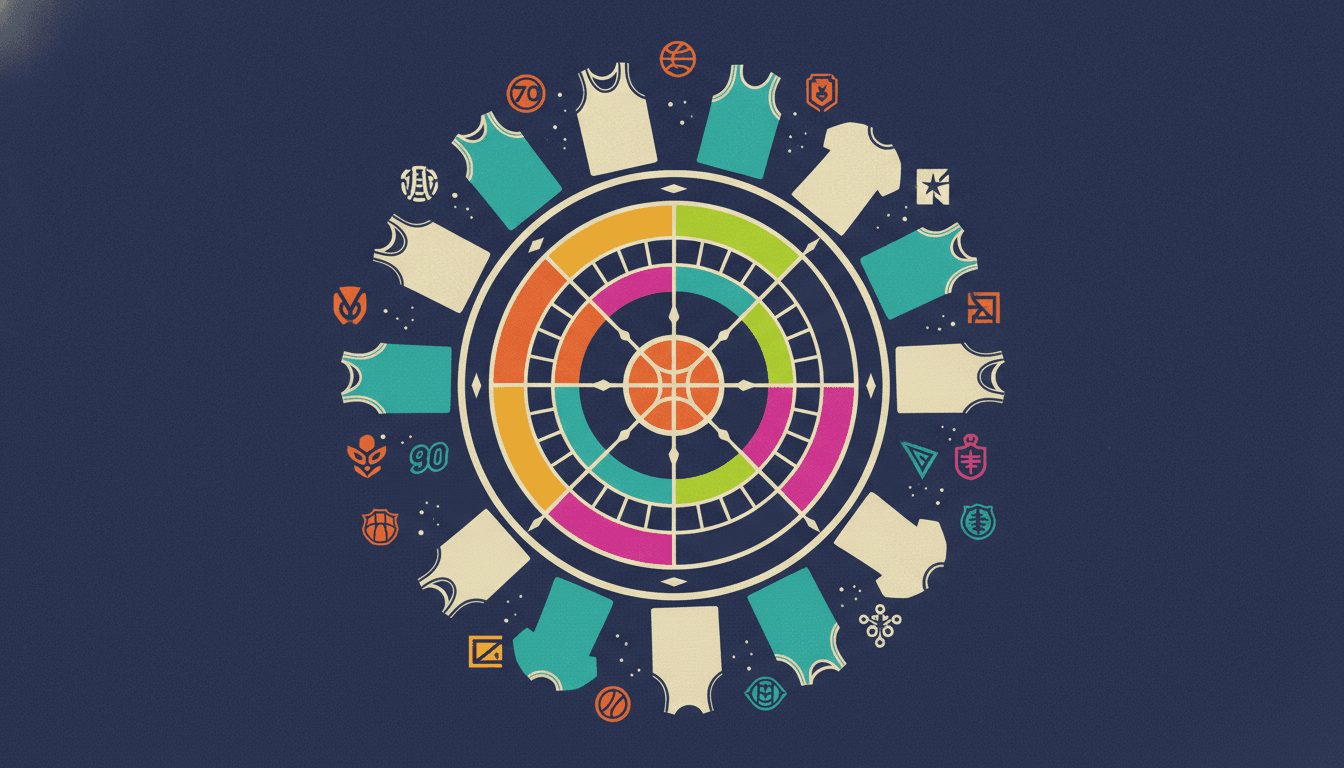
Era Ball describes itself as a basketball sim across eras: build an all-time NBA roster from legends across every decade, 50s through 2020s, draft players, pick a coach, and simulate a full season and playoffs. You pick a decade for the simulation first, then spin for franchise eras one slot at a time, and the players you land on are rated for how they played in their own decade - which may be forty years from the one your season runs in.
It plays in the browser at eraball.com and as a free iOS app with a one-time $4.99 purchase to remove ads. The App Store listing counts 4,500-plus players and 360-plus real coaches across eight decades. The site calls itself an unofficial fan project, not affiliated with or licensed by the NBA, and its footer reads like a small independent build: a Discord, a Ko-fi and a wall of founding supporters. One mode, Franchise, is app-only.
How a Round of Era Ball Works
A normal draft runs in a fixed order. Pick your simulation era, 50s through 2020s - the decade whose rules and trends your season will follow. Then spin. Each spin lands on a franchise and an era of that franchise, and you choose one player from everyone who played for that team in that decade to fill an open slot. You fill nine: five starters at point guard, shooting guard, small forward, power forward and center, plus four bench players. Starters play 35 minutes a night and carry more weight than the bench. You get one respin for the entire draft, so a dead spin is a real decision.
Two penalty systems shape every pick. Positional fit: a player at his natural spot takes no penalty, one position off costs 10 percent of his rating, way out of position costs 25 percent, and FLEX players (the site names LeBron, Jokić and Giannis) fill multiple slots for free. The era modifier: every player performs best in his home decade, each decade of distance adds a larger penalty, and pre-three-point players from the 50s through 70s take an extra hit in modern eras. Special tags sit on top: Defensive and Offensive Anchors who add impact beyond their stats, championship players who lift in the playoffs, and more.
Then you draft a coach with separate offense and defense grades from A to F, guru tags and a bonus for championship pedigree, and you simulate: 72 games in the 50s and 60s, 82 otherwise, with half your games needed to reach an era-accurate playoff bracket. The game warns that performance varies run to run - the same stars will not always produce the same result.
Era Gauntlet: The Roguelike Mode
The Era Gauntlet is why "era ball gauntlet" is its own search. It is a roguelike run across multiple eras: draft your coach first, then your roster, then play through segments of games before facing that era's boss team in a series. Beat the boss and you hop forward into the next era, where your whole roster is re-rated for the new decade - the 1960s big man who anchored your first act is suddenly playing in a league with a three-point line. Lose a boss series and you do not die outright; it costs Owner Patience, and you get a retry against a fresh matchup. Run out of Patience and you are fired. Rest, Free Agency and badges manage Patience, and the Gauntlet has its own cumulative leaderboard that feeds your account's Overall rating.
The App Store description fills in the shape: nine drafted players, four segments per act, every act ending against a real dynasty boss from the 1957 Celtics to the 2025 Thunder, and four maps including a full eight-decade Odyssey. The 1957 Celtics were Bill Russell's rookie team and won Boston's first championship, beating the St. Louis Hawks; Russell finished with 11 titles in 13 seasons. The 2025 Thunder beat the Indiana Pacers in the Finals.
The Other Modes, and How Often Each Resets
The main menu is deep. Normal Draft is the classic. Salary Cap Draft adds tier limits - two S-tier, two A, two B, two C and one D - with every spin guaranteeing a player from a tier you still need, on its own leaderboard. Sandbox has no limits. Head to Head is real-time multiplayer against a friend. The League is a single-player tabletop RPG. Franchise, app-only, runs a team with real rosters and contracts for years.
On cadence, the "daily game" framing people search with is only half right. The core draft modes are unlimited: play as many seasons as you want, with a leaderboard for every era in every mode. The Weekly Challenge is the scheduled one - new draft and sim rules and a new leaderboard every week, now split into Easy, Medium and Hard. The actual daily puzzles live on the Mini Games page, which promises a new puzzle every day at midnight, your time: Daily Card (guess the player, era and team in 15 tries), Higher or Lower (one life, 15 rounds), Franchise Roulette (a whole era roster in 120 seconds), Deep Cut and State Hunt. Mini games do not touch the leaderboards or your Overall rating.
How to Play Era Ball Well
Era Ball is a knowledge game dressed as a luck game.
Draft inside the era when you can. The era modifier is the biggest tax in the game, and in-era players pay none of it. A good 1960s starter in a 1960s sim often beats a legend dragged thirty years from home.
Respect the three-point line's birthday. The NBA adopted the line for the 1979-80 season, on a one-year trial at first, and teams averaged 2.8 three-point attempts a game that year. In 2024-25 the league average was 37.6. Era Ball's extra penalty on pre-three-point players is a direct reading of that gap.
Know what the old decades looked like. The 24-second shot clock arrived for 1954-55, and the 1960s were a rebounding era: Wilt Chamberlain's 1961-62 season was 50.4 points and 25.7 rebounds a night across 80 games, at 48.5 minutes a game. A 50s or 60s sim rewards the glass and the paint; a 2010s sim rewards spacing and playmaking, the decade in which Stephen Curry made 402 threes in a single season, 2015-16.
Save the respin for a dead spin, not a mediocre one. Most franchise-eras hold at least a useful role player; the one respin exists for the offer with nothing you can start. Use FLEX players to cover a thin position, and remember that championship tags pay in the playoffs - a slightly weaker roster with rings can outrun a regular-season monster in a seven-game series.
Where Era Ball Can Frustrate
Everything here follows from how the game is built, and players will weigh it differently. One respin per draft means a single bad wheel can decide a run before it starts, which stings most in a long Gauntlet. The simulation is deliberately variable - the game says so - so an identical draft can win 70 games one run and lose in the first round the next. The menu is wide, and a new player can spend a while learning tiers, tags and Patience. The free tier runs ads, with a paid removal. And because the core modes are unlimited rather than one-a-day, there is no shared daily board to compare with friends outside the Weekly Challenge and the Mini Games - everyone's wheel is their own.
Games Like Era Ball
If what you like is the mechanic - spin, draft across decades, sim - the nearest match is airball.gg's Era Draft, covered next. If what you like is the era knowledge itself, several daily formats test it from different angles: Era Ball's own Mini Games, grid games like Immaculate Grid that cross franchises with awards and eras (our NBA grid game guide covers the format), and the three airball.gg games below. All of airball's games are free, reset daily at midnight your time, and need no signup.
Era Draft on airball.gg: The Closest Match
Era Draft is airball.gg's take on the era-roulette team builder. Every day has one simulation era - a decade whose rules and trends shape your season. You spin a roulette of franchise eras, each landing on a team and a decade (the 1990s Bulls, the 1960s Celtics, the 1970s Kentucky Colonels), and pick any player from that team-era roster. You fill five starting positions and four bench spots, draft a coach, and get two respins for the whole draft - you can even respin a respin. Players perform at their rating from that decade, taxed for playing out of position or far from their home era. The season sims instantly, 72 games in 50s and 60s sims and 82 otherwise; win half to reach an era-accurate bracket.
Three choices set it apart. The wheel spans over two hundred team-eras from the 1950s to the 2020s, ABA included, and every player is rated on what he did inside that decade - real season lines and honors, never a career average smeared across eras - so drafting is reading history. The daily scored run uses a shared seeded wheel: everyone faces the same spins in the same order, so the leaderboard compares drafting skill on identical luck. And after your first scored run of the day, practice mode is unlimited and unscored, which is where the 82-0 chase lives. A scored run is nine picks, a coach and an instant sim - a coffee break.
Higher or Lower: The Lives-Based Streak Game
Higher or Lower is the airball.gg game shaped most like a gauntlet: ten rounds, five lives, and your longest streak of correct calls is the score. Each round shows two named players with headshots and one career stat - points, rebounds, assists, a shooting percentage - reveals Player A's number, and asks whether Player B's is higher or lower. The category rotates every round, drawn from a bank of more than thirty.
Era knowledge is the whole edge. Cumulative totals favor long careers, per-game numbers favor peaks, and pace shifts what a good number is by decade, so a 22-point scorer in 1995 and one in 2024 are not the same player. Both players are visible from the start - a knowledge test, not a guessing game - and a run takes a couple of minutes.
Career Path: Read a Journey Across Decades
Career Path shows an NBA player's team-by-team journey as franchise logos with the years of each stint, and asks who it is. Three guesses per round; each wrong guess unlocks a hint, draft position first and then college or country, and costs a point, so a no-hint solve is worth three. Five rounds a day run easy to expert, from a household name to a deep cut with a long journey.
The era is the first thing to read. A path that starts in 1999 rules out everyone who debuted in the 2000s, and a one-year stop at the end is often a ring-chasing veteran season. Relocated franchises show under their current logo with the original years, so a Seattle stint appears as Oklahoma City and a New Jersey stint as Brooklyn. Five rounds take five to ten minutes.
Top 10: Name Every Era on a Leaderboard
Top 10 hands you an all-time stat category - career points, rebounds, assists, threes made, blocks, steals, or an award or title count - and asks you to name every player on the leaderboard with a fixed number of guesses. Most boards are ten deep; award boards run to a five or an eight because only that many players qualify. There is no clock, and your score is the number of slots you filled.
It is the airball game most rooted in deep history, and the one with no era restriction at all. The winning habit is to think era by era: every cumulative list mixes 1960s and 70s volume, the 1980s and 90s peak, and modern grinders, and a player who has only named modern stars has usually missed half the board. A board takes a few minutes; the last two slots take most of them.
Why Era Games Are Hard, and Why That Is the Fun
Every game in this guide rests on the same uncomfortable truth: basketball has not been one sport for eight decades, it has been several, and most fans only know one of them fluently. The shot clock, the three-point line and the pace of the modern game each rewrote what a great player looks like, which is why a 25-rebound season and a 400-three season can both be real and both be unrepeatable. Era Ball turns that into a tax you feel on every pick; Era Draft turns it into a daily shared wheel; Higher or Lower, Career Path and Top 10 turn it into recall. They reward the fan who can place a name in its decade, estimate what that decade's numbers meant, and resist the pull of the familiar star over the right one. That is a hard skill and a satisfying one, which is why "one more run" is both the complaint and the compliment.
Related Reading
- NBA Grid Game: How to Play the Daily Basketball Grid
- NBA Wordle: The Best Daily Basketball Guessing Games
- Best NBA Trivia Games to Play Online in 2026
- NBA Trivia Questions by Decade: 1980s to 2010s
If the era wheel is what brought you here, spin ours. Play today's Era Draft - the same shared wheel for everyone, two respins, one scored run and an 82-0 to chase - then test the era knowledge it demands in Higher or Lower.