
A dynasty in the NBA isn't just about winning one championship - it's about sustained dominance that reshapes the sport around it. These teams didn't just collect rings; they redefined what basketball could look like, how rosters could be constructed, and what standards the entire league was measured against. The dynasties below didn't share a single template. One was built on defensive suffocation, another on fast-break joy, another on silent organizational competence that baffled everyone trying to replicate it. What they had in common was the rarest thing in professional sports: the ability to win not once, not twice, but deep into the era they created. How well do you actually know them?
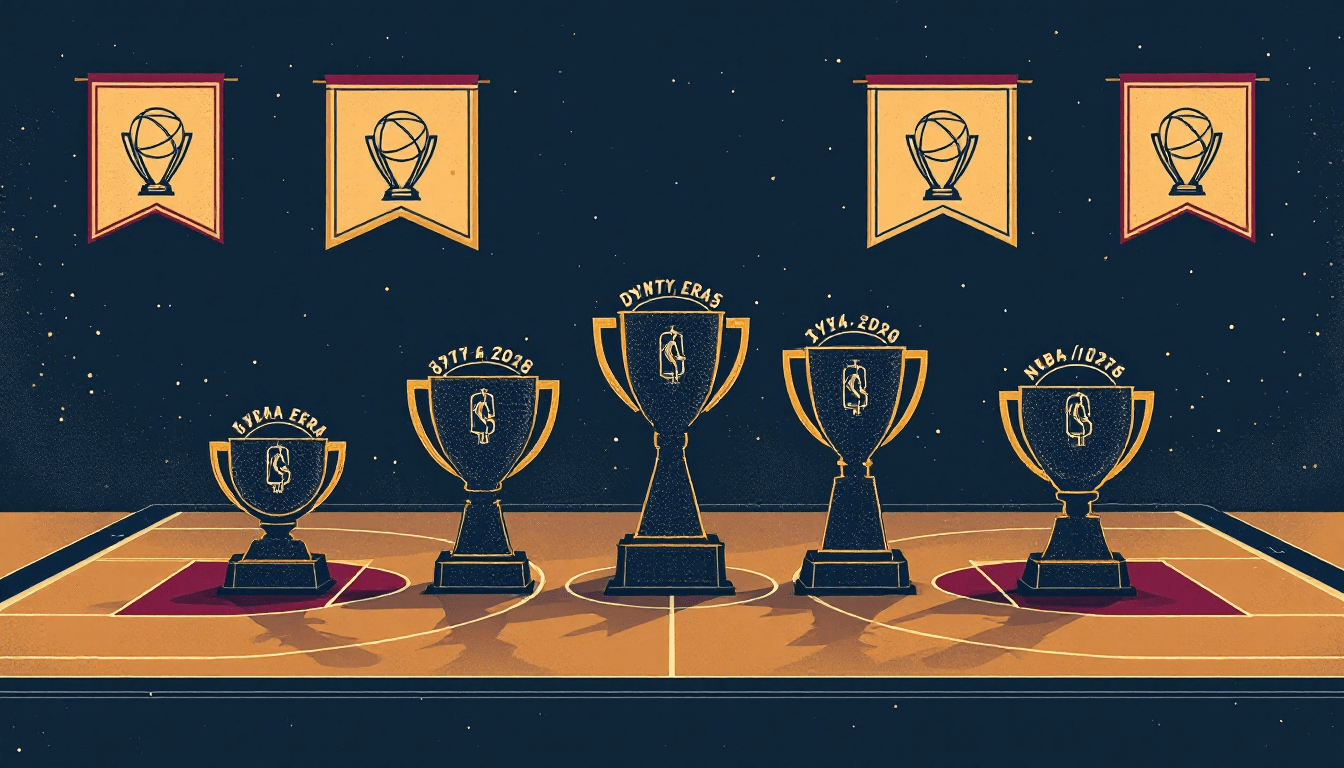
The Bill Russell Celtics - Eight Straight and Eleven in Thirteen
Start here, because nothing else in professional sports history comes close. The Boston Celtics won eleven NBA championships in thirteen seasons between 1957 and 1969, with Bill Russell at the center of every single one. Eight of those came consecutively from 1959 through 1966 - the longest championship streak in the history of North American professional sports, and a record that has never been approached.
Russell won five MVP awards during the dynasty's core years (1959, 1961, 1962, 1963, and 1965), tied for second-most all time behind Kareem Abdul-Jabbar's six. The Celtics built their title runs on defensive intensity rather than scoring - Russell was a force of nature as a shot-blocker and rebounder who changed the geometry of defense - surrounded by an extraordinary supporting cast in Bob Cousy, Sam Jones, John Havlicek, and Tom Heinsohn. Red Auerbach coached the early titles and assembled nearly all the pieces before stepping aside.
Most remarkable: when Auerbach moved upstairs before the 1966-67 season, he named Russell as player-coach, making Russell the first Black head coach in major North American professional sports. Russell then led the Celtics to two more titles in 1968 and 1969, finishing his career 10-0 in deciding Game 7s. The franchise Auerbach built won sixteen championships in total during his tenure as coach and executive - a standard that no front office in any league has equaled.
The Larry Bird Celtics - Three Titles and the Greatest Team of the Era
Often lost in the shadow of the Russell era, the Bird-era Celtics were a dynasty in their own right. Boston won three championships in 1981, 1984, and 1986 under coach K.C. Jones, with Larry Bird, Kevin McHale, and Robert Parish forming one of the greatest frontcourt combinations the game has produced.
Bird won three consecutive MVP awards from 1984 through 1986 - the only forward in league history to accomplish that. The 1985-86 Celtics finished 67-15, the best record in the league that year, and dispatched the Houston Rockets 4-2 in the Finals. Historians and analysts frequently rank that team as one of the greatest in NBA history - Bill Simmons placed it first on his all-time list, and the Celtics' 40-1 home record that season set an NBA mark that stood for decades.
The Bird Celtics also gave the league its defining rivalry of the 1980s. Boston met the Los Angeles Lakers in the Finals three times between 1984 and 1987, winning twice and producing some of the most competitive and watched basketball in the sport's history. That rivalry is where the modern NBA's national television identity was forged.
The Showtime Lakers - Five Titles and the Blueprint for Entertaining Basketball
On the other side of that 1980s rivalry were the Showtime Lakers, who reached the NBA Finals nine times and won five championships between 1980 and 1988. Magic Johnson and Kareem Abdul-Jabbar are the headline pairing, but the team's genius was systemic - run-and-gun pace, relentless transition offense, and a supporting cast including James Worthy, Byron Scott, and Michael Cooper that was nearly impossible to exploit defensively.
Magic arrived as a 20-year-old rookie and immediately produced one of the signature performances in Finals history. With Kareem - the league's MVP that year - sidelined with a severe ankle sprain in Game 5 of the 1980 Finals, Magic started Game 6 at center and scored 42 points, grabbed 15 rebounds, and handed out seven assists in a 123-107 clinching victory over the Philadelphia 76ers. He became the only rookie in NBA history to win Finals MVP. His series averages - 21.5 points, 11.2 rebounds, 8.7 assists - across those six games remain one of the most complete statistical Finals performances ever posted.
Pat Riley coached four of the Lakers' five 1980s championships and introduced the phrase "threepeat" to the lexicon when Los Angeles won back-to-back titles in 1987 and 1988. That 1988 repeat made the Lakers the first team since the Russell Celtics to win consecutive championships, a fact that underscores how rare sustained dominance truly is.

The Michael Jordan Bulls - Six Titles, Zero Finals Losses
The Chicago Bulls' two three-peats from 1991-1993 and 1996-1998 produced one of the most statistically dominant stretches any team has put together. Michael Jordan, Scottie Pippen, and Phil Jackson won six championships - and the Bulls are the only franchise in NBA history to win multiple championships without ever losing an NBA Finals series.
The first three-peat established the Bulls as elite. The second was historic on a different scale. After Jordan's baseball sabbatical, Chicago added Dennis Rodman in the 1995 offseason, and the 1995-96 Bulls went 72-10 - the best regular-season record in NBA history at the time - with Jordan averaging 30.4 points per game and winning league MVP. Rodman led the league in rebounding for the fifth straight season that year, and Jackson was named Coach of the Year. The Bulls then won three more titles, never dropping more than five games in any Finals series, capping the run with Jordan's famous 1998 shot over Bryon Russell to beat Utah.
Rodman led the league in rebounding for all seven seasons from 1992 through 1998 - a streak that started with the Detroit Pistons and continued through San Antonio and then Chicago. For the three years he played with Jordan and Pippen, his rebounding dominance was a structural advantage the Bulls' opponents couldn't neutralize.
Phil Jackson's record as a coach across this dynasty and the subsequent Laker run is 11 championships total - six with Chicago, five with Los Angeles - the most of any coach in NBA history.
The Shaq-Kobe Lakers - Three-Peat in the Modern Era
From 2000 to 2002, Shaquille O'Neal and Kobe Bryant won three consecutive championships and became the first team since the Jordan Bulls to complete a three-peat. The Shaq-Kobe Lakers were different from Showtime in almost every tactical respect - built on O'Neal's paint dominance and Bryant's wing scoring rather than pace and transition - but they were just as overwhelming.
The 2001 postseason was the statistical peak. The Lakers went 15-1 through the playoffs - the best postseason record in NBA history at the time - defeating Portland, Sacramento, San Antonio, and Philadelphia on the way to the title. O'Neal averaged 33.0 points, 15.8 rebounds, and 3.4 blocks per series in the Finals alone, and won his second consecutive Finals MVP. His Finals MVP in 2000, 2001, and 2002 gave him three straight - a feat matched only by Jordan (1991-93) and LeBron James (2012-13). Kobe Bryant was 21 years old when they won their first title together.
Jackson coached this team too, making him one of the most consequential figures in any discussion of team dynasties - the architect linking the 1990s Bulls to the early-2000s Lakers.
The San Antonio Spurs - The Greatest Organization in Basketball History
The argument for the San Antonio Spurs as the greatest franchise dynasty isn't just the five championships - 1999, 2003, 2005, 2007, and 2014. It's the span and the consistency. For fifteen years, under a single head coach, with a core of three players signed as draft picks, the Spurs never missed the playoffs, never had a losing season, and won titles in four different decades. No other franchise in NBA history has come close to matching that organizational record.
Tim Duncan won Finals MVP in 1999, 2003, and 2005 - three of the only four players in league history to win three Finals MVPs. His 1999 Finals averages of 24.0 points and 17 rebounds against the New York Knicks set the tone for what the Spurs would become: disciplined, physical, and fundamentally impossible to disrupt. The 2003 Finals against the Nets saw Duncan record a triple-double in the clinching game. By 2005, when San Antonio beat Detroit for their third title in seven years, the dynasty was fully established.
The 2014 championship against the Miami Heat - a 4-1 series that avenged a gut-punch 2013 Finals loss in seven games - is routinely cited as the most aesthetically complete team performance in modern NBA history. Kawhi Leonard, 22 years old, won Finals MVP after averaging 17.8 points on 61.2 percent shooting. The Spurs' ball movement, spacing, and collective decision-making in that series was covered internationally as a model for how the sport should be played.
Gregg Popovich became the all-time winningest coach in NBA history, surpassing Don Nelson on March 11, 2022, with his 1,336th regular-season win - ultimately finishing with over 1,390 wins across 29 seasons with the Spurs.
The Golden State Warriors - Four Titles and a Revolution in Playing Style
The Warriors' dynasty from 2015 to 2022 produced four championships in eight seasons and five consecutive Finals appearances from 2015 to 2019 - a streak unmatched in the modern NBA era. Stephen Curry, Klay Thompson, and Draymond Green were the core; Kevin Durant joined for the 2017 and 2018 titles before departing.
The 2015-16 Warriors went 73-9, breaking the Bulls' 72-10 regular-season record set in 1996. Then they blew a 3-1 lead to Cleveland in the Finals - the only team in Finals history to lose a series after leading 3-1 at that stage - and used the sting of that collapse to drive two back-to-back championships in 2017 and 2018 with Durant on the roster. Durant won Finals MVP both years.
The 2022 title - won without Durant, with an aging Thompson returning from consecutive serious injuries - is the one that cements the dynasty's full legacy. Curry averaged 31.2 points, 6.0 rebounds, and 5.0 assists per game in the Finals against Boston, the first player in Finals history to average 30-5-5 with 5 made three-pointers per game. He was named Finals MVP for the first time in his career. The Warriors' final championship record of four titles in eight years places them alongside the Lakers of the 1980s and the Celtics of the 1980s in the tier just below the Russell Celtics and the Jordan Bulls.
What the Warriors changed structurally is as important as the rings. Their three-point volume, pace-and-space spacing, and willingness to play small lineups that stressed defense across five positions influenced every front office in the league. The game played today - the spacing, the three-point economy, the switchable defender premium - traces directly back to what Golden State made impossible to ignore during this run.
What Every Dynasty Has in Common
The dynasties above span seven decades and look almost nothing alike tactically. Yet every one of them shares the same structural ingredients.
An immovable center of gravity. Russell, Bird, Magic, Jordan, Duncan, Curry - each dynasty anchored itself to one player whose presence was non-negotiable. Every other roster decision organized around that gravity. When the center disappeared - Jordan to baseball in 1993, Duncan aging past effectiveness after 2014 - the dynasty ended precisely.
A coach who operated with full systemic authority. Auerbach, Riley, Jackson, Popovich, Kerr - none of these coaches were figureheads. Each designed a team identity that exceeded any individual player, made that identity reproducible across seasons, and held players accountable to it. The dynasties without consistent coaching - including the early versions of most franchises on this list - never became dynasties at all.
A willingness to assemble rather than just draft. Russell's Celtics were built by a GM who understood what players needed around the anchor. The Showtime Lakers made trades for Worthy. The Bulls added Rodman. The Spurs drafted Manu Ginobili in the second round and signed Tony Parker as a teenager. The Warriors brought in Durant. Every dynasty had one or two key acquisitions that separated it from a very good team.
Durability of the core. The dynasties that accumulated the most rings had cores that aged together through multiple seasons without catastrophic injury breaking the window. The Spurs went fifteen years on a three-man spine. The Warriors returned after KD's departure and won a fourth title. The Russell Celtics simply never broke - Auerbach's roster management across those thirteen years was as important as any individual talent.
The NBA has never had two genuine dynasties running simultaneously. Every era has room for one. The Jordan Bulls squeezed out any rival ambitions. The Spurs-era overlap with the Lakers was real but brief. The Warriors made four Finals against a LeBron-era Cleveland team that was formidable but not quite a dynasty by the standards above. Dynasties don't coexist - they eliminate the conditions that allow other dynasties to form. That's the definition of dominance.
Related Reading
- The Greatest Rivalries in NBA History
- Michael Jordan vs Tim Duncan: Comparing Two Different GOATs
- The Greatest NBA Coaches of All Time
- The 2016 Cavaliers 3-1 Comeback: The Greatest NBA Finals Rally Ever
- NBA Players With the Most Championships
- NBA Players Who Won Titles With Multiple Teams
- NBA Teams Quiz: How Well Do You Know All 30 Franchises?
- NBA Logo Quiz: Can You Name All 30 Teams by Their Logo?
- How NBA GMs Actually Build a Contender
- The Best Duos in NBA History
Dynasty players and championship eras are exactly the kind of knowledge that separates trivia specialists from casual fans. Test your recall with our daily Who Am I? game, where mystery players hide behind clues spanning every era of NBA dominance - from the Russell Celtics to the Warriors' four-ring run.